AI Appraisal Estimate

AI-generated estimates · not official valuations

From the user

What was submitted

Photo and notes provided by the user — not generated by AI

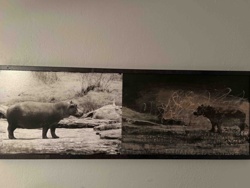
Submitted item photo
Submitted photo · June 21, 2026

User's notes

Unknown Artist, UnTitled original artwork

AI analysis below

AI appraisal

AI analysis & estimate

AI-Generated · Verify before acting

Everything below is generated by AI for informational purposes only. AI can make mistakes — the AI may misidentify items or misattribute them (artist, maker, brand, designer, origin, era). This is not an official valuation and should not be used for insurance, sale, tax, estate, legal, or lending purposes — or any decision requiring a certified appraisal. It is not an authoritative claim about any person, brand, or rights holder — do not share or rely on it as a factual statement about a third party. Always consult qualified professionals before making financial decisions.

Note

This analysis also relies on unverified notes provided by the user, which may be incomplete or inaccurate and could affect the result.

Read the full disclaimer

AI Identification

·Not independently authenticated·Verify before acting

Mixed-Media Assemblage Triptych / Shadow Box Art

Contemporary Mixed-Media Art

AI Estimated Value

·Not an official valuation·Verify before acting

$100 - $300

As of June 21, 2026

AI Item Analysis

·AI can make mistakes·Verify before acting
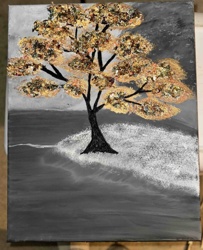
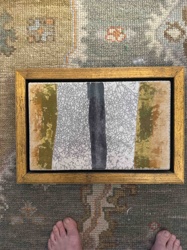
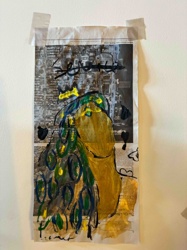
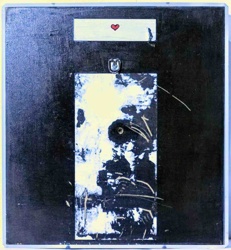
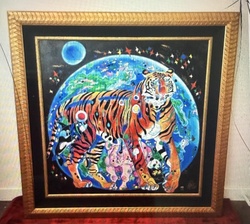
This is an original untitled mixed-media assemblage or shadow box creation by an unidentified contemporary artist. The work is constructed within a rectangular frame or box, featuring a heavily textured and layered composition. Central to the piece is a bouquet of dried flora, including what appear to be small rosebuds or thistles, encased behind a clear, wavy epoxy or resin pour that gives the surface an organic, rippled texture. The background incorporates found imagery, including a golden rectangular foil elements, a faint figure in an orange/nude tone on the right, and a circular red-and-green graphic element near the bottom right. A large, dark, organic shape—possibly a stone or heavy wad of cloth—is adhered to the left side, while the bottom of the frame is anchored by a thick, purplish-brown tubular object resembling a seed pod or leather pouch. The color palette is dark and somber, dominated by deep grays, blacks, and browns, contrasted against pops of gold leaf and muted reds. The craftsmanship is expressive and visceral, typical of mid-to-late 20th-century or 21st-century assemblage art. Condition shows deliberate distressing, though some edge wear on the red frame and dust accumulation within the resin crevices are visible.
AI Appraisal Report

·AI can make mistakes·Verify before acting
Based on a visual examination of this mixed-media assemblage, the work appears to be a unique, original creation likely dating from the late 20th to early 21st century. The piece demonstrates a strong competency in the assemblage tradition, reminiscent of Joseph Cornell's shadow boxes or the darker textures of Anselm Kiefer, utilizing resin, dried flora, and found objects to create a somber, atmospheric composition. The application of the wavy epoxy and the layering of foil and organic materials suggest a skilled hand, though the deliberate distressing makes it difficult to distinguish artistic intent from actual condition issues like the observed edge wear on the red frame. Evaluating the market value for this piece is heavily constrained by the lack of an identified artist. In the current market, 'Unknown' assemblage art is typically valued purely on decorative appeal and craftsmanship rather than collectible investment potential. While the aesthetic is compelling and fits distinct interior design niches (e.g., gothic, industrial, or macabre styles), the absence of a signature or provenance limits it to the 'decorative art' secondary market. Comparable works by anonymous artists in this medium generally sell at local auctions or online marketplaces within the low-to-mid hundreds. Authenticity in this context refers to it being a genuine artisan creation rather than a mass-produced item, which appears true here. However, without a physical inspection to check the verso for hidden signatures, gallery labels, or inventory numbers, deeper attribution is impossible. Validating the materials (e.g., the stability of the organic matter within the resin) would also require in-person handling. Consequently, the value is derived strictly from its visual impact as an object of curiosity.

Get your items appraised

Instant estimates of your treasures with AI-powered appraisals

Browse More Appraisals