These notes were written by the person who submitted this item. Appraiser.AI has not verified them, and the AI's identification and estimate may rely on them.
AI Estimated Value
Not an official valuation
$800 - $1,200
AI estimate as of December 7, 2025 · verify with a professional before acting
AI-Generated · Verify before acting
Everything on this page is generated by AI for informational purposes only. AI can make mistakes — the AI may misidentify items or misattribute them (artist, maker, brand, designer, origin, era). This is not an official valuation and should not be used for insurance, sale, tax, estate, legal, or lending purposes — or any decision requiring a certified appraisal. It is not an authoritative claim about any person, brand, or rights holder — do not share or rely on it as a factual statement about a third party. Always consult qualified professionals before making financial decisions.
This analysis also relies on unverified notes provided by the user, which may be incomplete or inaccurate and could affect the result.
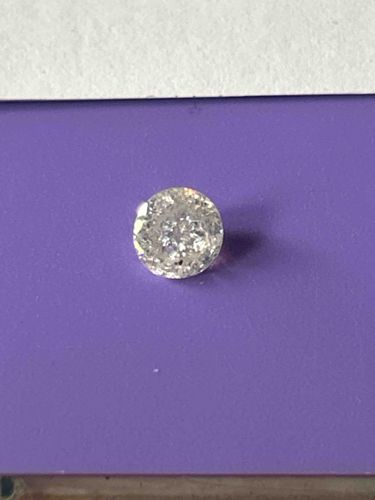
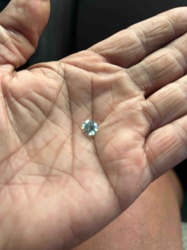
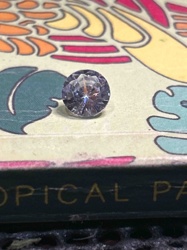
The item is a loose diamond, appearing to be a round brilliant cut, which is one of the most popular and classic diamond shapes. The color of the diamond appears to be within the near-colorless to faint yellow range, though precise grading would require professional equipment and lighting. It exhibits significant brilliance and fire, as evidenced by the numerous flashes of light and sparkle visible across its facets. The cutting style features multiple triangular and kite-shaped facets designed to maximize light return and create scintillation. While the exact size cannot be determined from the image alone, it appears to be a smaller stone, possibly accent size, given its appearance on the purple background. There are no visible chips, cracks, or significant abrasions discernable from the image, suggesting good to excellent condition in terms of surface integrity. Inclusions, if present, are not overtly visible without magnification, which could imply a clarity grade of SI (Slightly Included) or higher. The diamond is currently unmounted, displayed against a solid purple background, which is a common practice for showcasing the stone's inherent color and clarity without external influences. Its lack of any setting suggests it is either newly cut, awaiting a setting, or perhaps removed from a piece of jewelry for inspection or re-setting. There are no visible maker's marks or signatures as it is a loose gemstone. The craftsmanship is evident in the symmetrical arrangement of facets, indicating a well-cut stone that effectively reflects light.
AI Appraisal Report
I have examined the provided image of this Round Brilliant Cut Loose Diamond. Visually, the diamond presents as a well-cut stone, exhibiting significant brilliance and fire, which suggests a good to excellent cut grade. The facet arrangement appears symmetrical, indicative of quality craftsmanship. Its color appears to be in the near-colorless to faint yellow range (G-I color range likely), and I see no overt inclusions without magnification, leading me to estimate a clarity grade of SI1-VS2. The surface integrity appears excellent with no visible chips or abrasions. As a loose diamond, it is ready for setting, which typically increases its market appeal.
Market conditions for round brilliant diamonds are robust, as they remain the most popular cut due to their exceptional light performance. While it appears to be a smaller stone, potentially accent-sized (estimated 0.50-0.75 carat based on typical display methods), its overall quality points towards a desirable item. Demand for quality loose diamonds, particularly in the near-colorless range with good clarity and cut, remains consistently high. Rarity, in this size and quality, is moderate.
Factors significantly impacting value include its strong visual appeal, suggested high-quality cut, and estimated clarity and color grades. However, it is crucial to note that this appraisal is based solely on the provided image. Limitations in authenticity verification are significant; I cannot definitively confirm it is a natural diamond without scientific testing (e.g., Raman spectroscopy, UV fluorescence) to rule out synthetics or treated stones. Exact carat weight, precise color and clarity grading, and minor inclusion plotting would require in-person examination by a certified gemologist using specialized equipment (e.g., microscope, colorimeter, proportion scope). Provenance documentation, such as a GIA or AGS grading report, would also be essential for full authentication and a more precise valuation.