AI estimate as of July 24, 2025 · verify with a professional before acting
AI-Generated · Verify before acting
Everything on this page is generated by AI for informational purposes only. AI can make mistakes — the AI may misidentify items or misattribute them (artist, maker, brand, designer, origin, era). This is not an official valuation and should not be used for insurance, sale, tax, estate, legal, or lending purposes — or any decision requiring a certified appraisal. It is not an authoritative claim about any person, brand, or rights holder — do not share or rely on it as a factual statement about a third party. Always consult qualified professionals before making financial decisions.
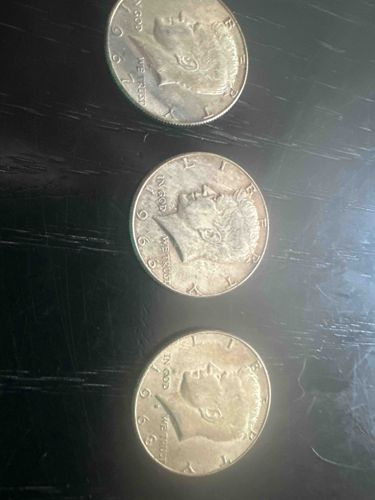
The image displays three United States Kennedy Half Dollars, arranged vertically on a dark, possibly black, surface. Each coin features the obverse (heads side) with a left-facing profile of President John F. Kennedy. The coins appear to be made of a silver-colored metal, consistent with the cupronickel clad composition of later Kennedy Half Dollars, though earlier issues (1964) were 90% silver and 1965-1970 issues were 40% silver. Given the visible dates, all three coins are from 1976. The inscription "LIBERTY" is partially visible around the top rim, and "IN GOD WE TRUST" is clear below Kennedy's chin. The date "1976" is prominently displayed at the bottom of each coin.
Collectively, the coins exhibit moderate circulation wear, with some loss of detail on Kennedy's hair and facial features, particularly noticeable on the high points. There are no major dings or deep scratches visible, but the surfaces show a general dullness and some minor surface abrasions consistent with typical handling over decades. There is a slight, uneven toning or patina discernible across all three coins, suggesting some oxidation of the metal. No mint marks are clearly visible in the provided image to determine the specific minting facility (e.g., Philadelphia, Denver, or San Francisco). The reeded edge characteristic of this denomination is not visible in this obverse-only view. These coins were issued as part of the United States Bicentennial celebration, featuring a special reverse design (not shown) depicting Independence Hall. The overall condition indicates that they have been in circulation but are largely intact without severe damage. The quality of striking seems consistent with general circulation coinage of the era, rather than proof or uncirculated specimens.
AI Appraisal Report
I have examined the provided image of three 1976 United States Kennedy Half Dollars. These coins, part of the Bicentennial celebration series, uniformly display the obverse design. Their cupronickel clad composition is consistent with common circulation strikes of this era. Based on the visual evidence, all three coins exhibit moderate circulation wear, characterized by a loss of detail on high points such as Kennedy's hair and cheek. There are no significant gouges or bends, but the surfaces show typical handling marks, minor abrasions, and a dulling of the original luster, suggesting they are in a Fine (F) to Very Fine (VF) collective condition range. The slight, uneven toning is indicative of environmental exposure over time.
Authenticity appears strong for genuine U.S. coinage as depicted. However, a definitive authenticity verification relies on in-person examination to confirm weight, diameter, thickness, and edge reeding, as well as to detect any signs of counterfeiting not visible in images. Microscopic analysis of die characteristics would further confirm.
From a market perspective, 1976 Bicentennial Kennedy Half Dollars were minted in large quantities, making them very common. Even in higher uncirculated grades, their individual value is typically modest. Given the circulated condition of these examples, their numismatic premium over face value is minimal. Demand for circulated specimens is generally low among serious collectors, though they hold sentimental value for some or are collected as part of a type set. Rarity is not a factor for these particular coins in this condition. The absence of visible mint marks prevents further specific valuation, though D, P, and S mintages (for circulation strikes) are also abundant. Proof versions (S-mint marked, in silver clad or 40% silver) would command higher values, but these do not appear to be proof strikes.
Factors significantly impacting value negatively are their circulated condition and high mintage numbers. Without physical inspection, I cannot confirm specific varieties or subtle mint errors that could increase value, but none are suggested by the image.
In summary, these are common circulated Bicentennial Kennedy Half Dollars.