AI estimate as of September 1, 2025 · verify with a professional before acting
AI-Generated · Verify before acting
Everything on this page is generated by AI for informational purposes only. AI can make mistakes — the AI may misidentify items or misattribute them (artist, maker, brand, designer, origin, era). This is not an official valuation and should not be used for insurance, sale, tax, estate, legal, or lending purposes — or any decision requiring a certified appraisal. It is not an authoritative claim about any person, brand, or rights holder — do not share or rely on it as a factual statement about a third party. Always consult qualified professionals before making financial decisions.
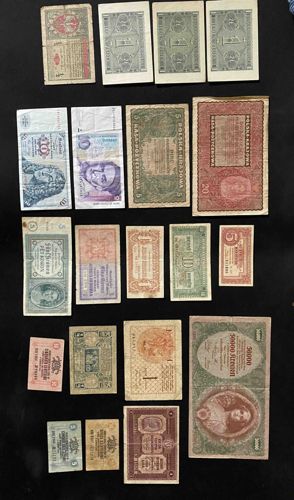
This collection comprises approximately 24 individual banknotes, predominantly appearing to be historical paper currency from various nations, most notably Eastern European or former Soviet bloc countries given the visible Cyrillic and other non-Latin scripts. The banknotes vary significantly in size, color, and design, indicating diverse origins and denominations.
Physical characteristics observed include rectangular shapes consistent with paper currency, ranging from small-format notes (e.g., those in the bottom left) to larger, more elaborate designs (e.g., the large green and red notes on the right). Colors span a wide spectrum from muted greens, browns, and grays to more vibrant reds, purples, and blues. The material appears to be paper, with some notes exhibiting a thinner, more fragile texture while others seem more robust.
Notable features include various artistic motifs, portraits of historical figures (visible on some larger notes), intricate border patterns, and numerous alphanumeric characters denoting currency, denominations, and serial numbers. Some notes clearly display a national coat of arms or other governmental emblems.
Visible condition issues vary greatly across the collection. Many notes exhibit signs of wear consistent with circulation, including creases, folds, softening of corners, and slight discoloration. Some appear to have minor tears or edge wear. The largest green and red notes on the right show significant creasing and perhaps some staining. The overall patina suggests age and handling. No obvious repairs or significant damage like large rips affecting the integrity of the note are immediately discernible from the image, but closer inspection would be required.
Manufacturing details, such as specific maker's marks or signatures, are difficult to ascertain without high-resolution images of individual notes. However, the presence of specific dates (e.g., '192_ ' visible on one note) and unique national symbols can help in identifying the issuing authority and year.
The style period appears to span several decades, potentially from the early to mid-20th century to possibly later periods, judging by the varying artistic styles and apparent currency reforms suggested by the diversity of designs. Many notes appear to be from periods of significant economic or political change, which often led to new currency issues and diverse designs.
Quality indicators and craftsmanship vary; some notes exhibit fine engraving and detailed printing, indicative of professional governmental minting, while others might be simpler in design. The variety in design and condition suggests that this is an accumulated collection rather than a set of uncirculated, pristine examples. The collection's uniqueness lies in its apparent historical scope and geographical diversity, offering a glimpse into the monetary history of various nations.
AI Appraisal Report
Having visually examined this collection of approximately 24 assorted vintage and historical banknotes, I can offer an appraisal based on the provided image. The collection predominantly features Eastern European or former Soviet bloc currency, with varying aesthetics, sizes, and denominations. Condition varies considerably, with most notes showing signs of circulation such as creases, folds, softening of corners, and some discoloration. Minor tears and edge wear are visible on some, particularly the larger green and red notes. Authenticity, based on visual cues typical of the period, appears genuine; I see no immediate red flags suggesting counterfeits. However, it's crucial to state that full authenticity verification is impossible from images alone. An in-person examination for watermarks, security threads, paper quality, and printing techniques, along with comparison to known authentic examples, would be necessary.
The market for circulated historical banknotes from these regions is generally stable but not highly lucrative for individual common notes. While there's a consistent demand from collectors interested in historical currency, the rarity of these specific notes without individual identification is difficult to ascertain. Most banknotes from periods of high inflation or political change, especially post-WWI and Soviet-era issues, were printed in vast quantities and are relatively common. The primary market consists of general collectors and history enthusiasts rather than investors seeking high-value rarities. Factors significantly impacting value include specific country, denomination, historical significance, verifiable errors, and critically, the notes' condition. The worn condition of many items here limits their top-end value. Without precise identification of each note's country, date, and denomination, and given their circulated state, this collection falls into the common to moderately desirable category. Comparables would be similar mixed lots of world banknotes in circulated condition. Individual pristine examples of rare issues would command significantly more, but these are not present here.
To fully authenticate and precisely value each note, I would require an in-person physical inspection, high-resolution scans or images of both sides of each note, and ideally, any provenance documentation the owner might possess. Scientific testing for paper composition or ink analysis is generally not pursued for notes of this likely value range unless a very rare example is suspected.