AI estimate as of August 11, 2025 · verify with a professional before acting
AI-Generated · Verify before acting
Everything on this page is generated by AI for informational purposes only. AI can make mistakes — the AI may misidentify items or misattribute them (artist, maker, brand, designer, origin, era). This is not an official valuation and should not be used for insurance, sale, tax, estate, legal, or lending purposes — or any decision requiring a certified appraisal. It is not an authoritative claim about any person, brand, or rights holder — do not share or rely on it as a factual statement about a third party. Always consult qualified professionals before making financial decisions.
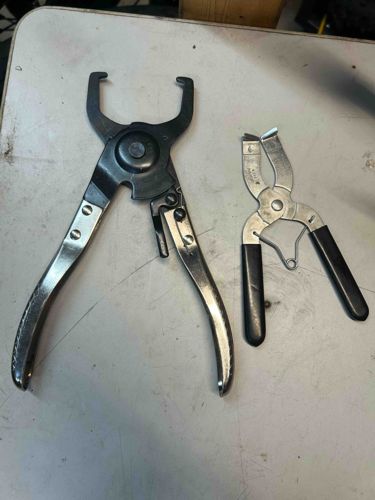
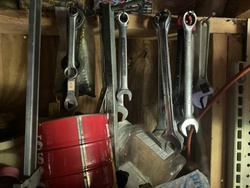
The image displays two distinct types of specialized pliers, both likely constructed from steel or a similar robust metal alloy, exhibiting a metallic silver-grey finish with some darker areas indicative of wear or original coating. The tool on the left is a larger, more heavy-duty retaining ring pliers, possibly for internal snap rings, characterized by its wide, curved jaws with inward-pointing tips, designed to compress (or expand) a ring. It has a visible pivot point and what appears to be a spring-loaded or cam mechanism near the handles to maintain tension or position. The handles themselves are solid and slightly curved, showing some minor surface scratches and dulling of the finish consistent with regular use. There are visible rivets on the handles. The tool on the right is a smaller, more refined plier, likely a hose clamp plier or a specific type of clamping tool, designed to hold or compress. It features a unique jaw configuration with flat, slightly angled ends, and a visible spring mechanism between the handles to keep them open. The handles are partially covered with black, possibly plastic or rubber, grips which also show some wear and dullness. Markings are visible on the smaller plier's jaw area, reading "DIAMOND" and "USA", indicating the manufacturer and country of origin. Both tools appear to be in used but functional condition, displaying typical signs of professional or personal workshop use such as scuffs, minor abrasions, and some loss of original luster due to handling and age. Their construction suggests a practical design focused on durability and specific utility rather than aesthetic appeal, common for tools from the mid-20th century onwards.
AI Appraisal Report
Upon examining the provided image of these Assorted Specialty Pliers, I've assessed their condition and potential value. Both tools exhibit typical signs of use consistent with professional or personal workshop environments. The larger retaining ring pliers show surface scratches and some dulling, but appear structurally sound. The smaller hose clamp pliers, with its 'DIAMOND USA' marking, also displays wear on the metal and grips, yet remains visibly functional. My primary assessment of authenticity is based on the discernible 'DIAMOND USA' marking, which points to Diamond Tool and Horseshoe Co., a reputable American manufacturer of quality hand tools. The design aesthetics and materials seem consistent with tools produced mid-20th century onwards.
In terms of market conditions, specialty pliers, particularly those from respected manufacturers, retain a modest demand among mechanics, DIY enthusiasts, and collectors of vintage tools. However, these specific types of pliers are not inherently rare. Their value is driven more by their utility and brand recognition than by scarcity or unique historical significance. Factors impacting value include the visible wear, which reduces collector appeal compared to pristine examples, but their apparent functionality maintains their practical value.
Comparables for used Diamond Brand tools of this nature often fall within a accessible price range. While specific models vary, general market trends for such used, functional hand tools suggest a moderate valuation.
Limitations in authenticity verification from images alone are significant. While the 'DIAMOND USA' mark is a strong indicator, a full authentication would require in-person examination to verify tool construction details, material composition (e.g., steel type), and to check for subtle counterfeit indicators not visible in photographs. Provenance documentation, such as original sales receipts or family history, would further solidify authenticity and could potentially add collector value. Scientific testing, like metallurgical analysis, could definitively confirm material and age but is generally not economically feasible for items of this valuation.