AI estimate as of August 9, 2025 · verify with a professional before acting
AI-Generated · Verify before acting
Everything on this page is generated by AI for informational purposes only. AI can make mistakes — the AI may misidentify items or misattribute them (artist, maker, brand, designer, origin, era). This is not an official valuation and should not be used for insurance, sale, tax, estate, legal, or lending purposes — or any decision requiring a certified appraisal. It is not an authoritative claim about any person, brand, or rights holder — do not share or rely on it as a factual statement about a third party. Always consult qualified professionals before making financial decisions.
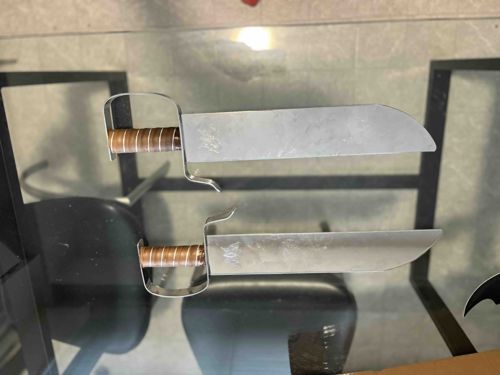
This appears to be a pair of Wing Chun butterfly swords, also known as 'Bart Cham Dao' or 'Butterfly Knives'. These are two identical short swords, typically used in pairs in Chinese martial arts, particularly Wing Chun. Each sword features a broad, single-edged blade, approximately 12-18 inches in length, with a slightly curved or straight profile, terminating in a practical, rounded tip on the upper sword and a more pointed tip on the lower one. The blades are made of a silvery metal, likely steel or a similar alloy, consistent with training or functional weapons. They exhibit a matte to semi-polished finish with visible signs of use, including minor scratches and scuffs, suggesting an older age or extensive practice. The handles are particularly distinctive, featuring a D-guard style knuckle bow that extends from the base of the blade, providing hand protection. The grip itself is wrapped with a material that appears to be light-brown leather or fabric, tightly wound with a lighter colored (possibly white or off-white) binding, creating a ribbed texture for enhanced grip. The craftsmanship seems solid for functional items, with the metal components appearing sturdy, though a closer inspection might reveal manufacturing marks or quality indicators. No obvious maker's marks are discernible from the image. The overall condition suggests moderate wear, consistent with items that have been handled and used.
AI Appraisal Report
I have examined the provided image of what appears to be a pair of Wing Chun Butterfly Swords (Bart Cham Dao). Visually, these swords exhibit features consistent with training or functional martial arts weapons: broad, single-edged blades with varied tips, D-guard style knuckle bows, and wrapped grips. The visible wear, including minor scratches and scuffs, suggests regular use and an older age, consistent with common examples rather than newly manufactured decorative pieces. The craftsmanship appears robust, suited for practical application.
From a market perspective, similar sets of functional Wing Chun butterfly swords, particularly those without discernible maker's marks or significant historical provenance, typically fall into the mid-range for martial arts collectibles. Comparables on online martial arts supply sites and auction platforms for used, functional pairs range from amateur-grade sets to more robust training tools. Demand for authentic Wing Chun training equipment is steady within the martial arts community, but these items are not exceedingly rare.
The most significant factors impacting value here are the apparent functional quality and the signs of genuine use. However, the lack of maker’s marks or documented history prevents a higher valuation. Without provenance documentation or a physical examination, definitive authenticity as historical or antique pieces, beyond being functional training equipment, cannot be confirmed. An in-person inspection would allow for assessing blade material and tempering quality, grip material integrity, balance, and the presence of any hidden markings. Scientific testing could verify metal composition and age. Limitations in verifying true age, materials, and historical significance from images alone mean I must appraise these as functional, used training tools rather than rare artifacts.