AI estimate as of August 9, 2025 · verify with a professional before acting
AI-Generated · Verify before acting
Everything on this page is generated by AI for informational purposes only. AI can make mistakes — the AI may misidentify items or misattribute them (artist, maker, brand, designer, origin, era). This is not an official valuation and should not be used for insurance, sale, tax, estate, legal, or lending purposes — or any decision requiring a certified appraisal. It is not an authoritative claim about any person, brand, or rights holder — do not share or rely on it as a factual statement about a third party. Always consult qualified professionals before making financial decisions.
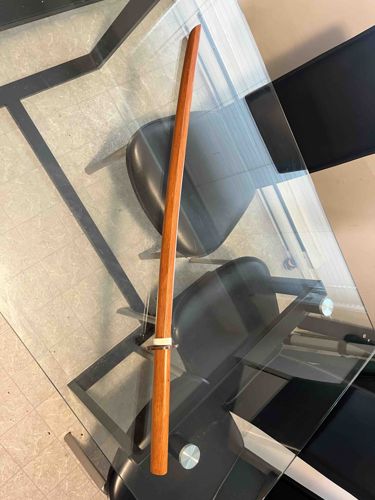
The item is a wooden bokken, also known as a bokuto, which is a Japanese wooden sword used for training in kenjutsu, kendo, aikido, and other martial arts. It appears to be made from a solid piece of hardwood, likely oak or possibly a lighter wood like red oak, given its reddish-brown hue and visible grain patterns. The bokken measures approximately in length, consistent with the size of a standard Japanese katana, though exact dimensions are not provided in the image. It features a realistic blade profile with a slightly curved form, a well-defined spine (mune), and a subtle edge (ha), typical of a practice weapon designed to simulate the feel of a real sword. The surface appears smooth and finished, possibly with a clear lacquer or oil treatment, enhancing the natural wood grain and providing a degree of protection.
A notable feature is the prominent white plastic or possibly natural material tsuba (handguard) located towards the handle (tsuka) end. This tsuba is simple in design, serving a purely functional role to protect the user's hands during practice. Below the tsuba, the handle section is cylindrical, providing a comfortable grip. There are no visible prominent maker's marks, signatures, or specific carvings on the bokken, suggesting it may be a mass-produced training tool rather than a custom-made piece. The overall condition appears good, with no obvious signs of significant wear, cracks, chips, or damage. The wood shows a consistent color and a clean, well-maintained appearance. There is no visible patina that would suggest significant age or extensive use. Given its simple yet functional design and lack of intricate details, it likely falls into a contemporary or relatively modern style period, primarily designed for practical martial arts training. The craftsmanship appears competent, with a smooth finish and accurate shaping, indicating a good quality training implement.
AI Appraisal Report
I have examined the provided image of this wooden bokken (bokuto) and offer the following appraisal. Based on its appearance, the bokken is in excellent condition, showing no visible signs of significant wear, cracks, chips, or damage. The wood grain is consistent, and the finish appears well-maintained, suggesting careful use or recent acquisition. Authenticity, as a functional training tool, seems clear from its design and apparent construction. It appears to be a standard production bokken, not a custom-made or artisan piece.
From a market perspective, bokken are widely available globally. Comparables include new hardwood bokken from reputable martial arts suppliers, which typically range from $25 to $75 depending on the wood type (e.g., red oak, white oak) and finish. This particular item, lacking any unique features, maker's marks, or historical provenance, aligns with the lower to middle end of this range for new condition examples. Demand for such training tools is consistent within the martial arts community, but rarity is low; they are mass-produced.
Factors significantly impacting value are primarily condition and material. This bokken’s good condition supports a value closer to new. However, the lack of definitive wood type identification (e.g., white oak, known for its superior durability, would fetch a slightly higher price than red oak) and the generic plastic tsuba keep its value in the utility range. Without physical inspection, I cannot confirm the exact wood species, the weight, or subtle balance characteristics, all of which influence a practitioner's preference and perceived value. Full authentication of material beyond visual assessment would require physical examination and possibly wood density or grain analysis. Provenance documentation would be needed to establish any historical significance, which this piece does not visually imply.