AI estimate as of September 27, 2025 · verify with a professional before acting
AI-Generated · Verify before acting
Everything on this page is generated by AI for informational purposes only. AI can make mistakes — the AI may misidentify items or misattribute them (artist, maker, brand, designer, origin, era). This is not an official valuation and should not be used for insurance, sale, tax, estate, legal, or lending purposes — or any decision requiring a certified appraisal. It is not an authoritative claim about any person, brand, or rights holder — do not share or rely on it as a factual statement about a third party. Always consult qualified professionals before making financial decisions.
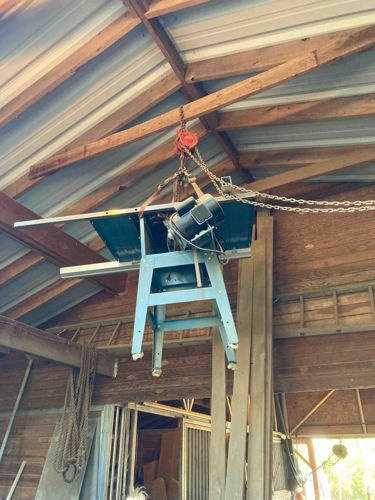
This item is a vintage table saw, currently suspended by chains and a red chain hoist from the rafters of what appears to be a shed or workshop with a metal roof. The saw itself is primarily constructed from metal, likely cast iron and steel, and is painted a light blue or teal color, showing some areas where the paint has chipped or worn away, revealing a darker material underneath. The main working surface, the table, appears to be made of polished metal, possibly cast iron, with some visible scuffs or minor surface oxidation, consistent with typical workshop use. An electric motor, black in color with some metallic components, is clearly visible attached to the underside of the table, indicating it is a motorized power tool. The saw features a sturdy, four-legged stand that forms its base, also painted the same light blue/teal color. The overall construction suggests a robust and heavy-duty tool, likely designed for woodworking. There are no clear manufacturer's marks or identifying labels visible from this angle. The age is estimated to be vintage, possibly mid to late 20th century, given the design and evident wear. The condition appears used but functional, with cosmetic wear such as paint chips and surface blemishes. The visible chain hoist and chains suggest it is being moved or stored. The lack of excessive rust or major damage indicates it has been reasonably maintained, despite its age and use.
AI Appraisal Report
Upon visual examination of the provided image, I assess this vintage table saw to be in used, but functional, condition. Authenticity is difficult to definitively confirm from images alone; however, the design, evident wear patterns, and robust construction are consistent with mid-to-late 20th-century woodworking machinery. The light blue/teal paint, chipped in areas, and the visible surface oxidation on the polished metal table are typical of tools of this era that have seen regular use but also reasonable care, preventing severe deterioration like deep rust. The presence of an electric motor confirms it is a motorized unit, common for such tools.
Market conditions for vintage table saws vary widely. General purpose vintage saws, unless from a highly sought-after brand (like Powermatic or Delta from certain eras), tend to populate the lower to mid-range of the used equipment market. Comparables for non-branded, generic vintage table saws in similar condition typically fall within the $200-$500 range, depending on motor size and table size/features. While robust, the lack of visible brand identification significantly impacts its upper value potential, as collectors often seek specific manufacturers. There is moderate demand for functional, affordable vintage woodworking equipment among hobbyists and small workshops. Rarity is low for this general type of saw. The suspension via chains suggests it’s either being moved or stored, which doesn't negatively impact its inherent value as a tool.
Factors significantly impacting value here are the absence of a visible brand, which limits collector appeal, and the aesthetic wear. These factors prevent it from achieving values commanded by premium vintage brands. For full authentication and a more precise valuation, an in-person examination would be crucial to assess motor specifications, blade arbor condition, table flatness, and overall mechanical integrity. Documentation of provenance or scientific testing of the materials would further confirm its origin and age, though this is rarely pursued for such items.