AI estimate as of August 16, 2025 · verify with a professional before acting
AI-Generated · Verify before acting
Everything on this page is generated by AI for informational purposes only. AI can make mistakes — the AI may misidentify items or misattribute them (artist, maker, brand, designer, origin, era). This is not an official valuation and should not be used for insurance, sale, tax, estate, legal, or lending purposes — or any decision requiring a certified appraisal. It is not an authoritative claim about any person, brand, or rights holder — do not share or rely on it as a factual statement about a third party. Always consult qualified professionals before making financial decisions.
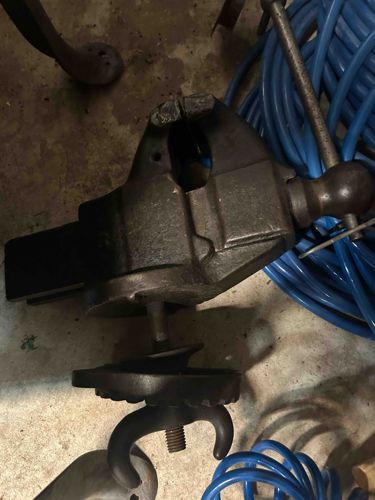
The item is a heavy-duty, cast-iron bench vise with a swivel base, designed for securing workpieces during various tasks such as filing, drilling, and machining. It appears to be made from a solid, dark-gray cast iron, indicative of its robustness and industrial application. The vise features a main body housing both fixed and movable jaws, with the movable jaw actuated by a large, threaded lead screw and a handle with rounded ends. The jaws themselves show signs of wear and chipping on the edges, particularly the upper corners, suggesting heavy use or impact. There is visible rust and grime, especially within the recesses and on the screw mechanism, consistent with prolonged use in a workshop environment and lack of recent maintenance. The swivel base allows the entire vise to rotate, which is secured by a locking mechanism or bolt not fully visible but implied by the typical construction of such vises. Below the main body, a threaded shaft extends downwards, connecting to a separate component with a hook-like protrusion and a further threaded stub, indicating it's either an incomplete mounting system or a specialized attachment. The craftsmanship appears to be functional and durable, typical of utilitarian tools from the mid-20th century or earlier, rather than decorative. The overall condition suggests a working tool, likely vintage, showing substantial signs of age and operational wear, but still fundamentally intact.
AI Appraisal Report
Based on my visual examination of the Cast Iron Bench Vise with Swivel Base, I assess its condition as fair to good, exhibiting significant signs of practical use and age. The authenticity appears unquestionable as a genuine vintage cast-iron bench vise, consistent with industrial tooling from the mid-20th century or possibly earlier. The visible rust, grime, and chipping on the jaws are indicative of prolonged occupational wear rather than neglect. The presence of the threaded shaft and hook-like protrusion at the base suggests either a specialized mounting system or potentially an incomplete original setup; clarifying this would require in-person inspection.
Current market conditions for vintage workshop equipment, particularly vises, show steady demand among hobbyists, restorers, and small-scale fabricators who value durability and historical accuracy over modern, often less robust alternatives. While not exceptionally rare, a functional, heavy-duty cast-iron vise of this apparent quality holds appeal. Factors impacting value include the visible wear on the jaws, which might necessitate repair or replacement for precision work, and the extent of the rust, which could indicate deeper pitting not visible in the image. The specific manufacturer (if identifiable) would also significantly influence value. Without a clear manufacturer's mark, in-person examination to assess the smoothness of the screw mechanism, rigidity of the swivel base, and overall structural integrity is crucial. Authenticity verification limitations solely from images mean I cannot confirm internal wear, precise material composition, or the absence of repairs masked by grime. A physical inspection, along with any provenance documentation (e.g., original sales receipts or family history), would provide the necessary context for absolute authentication and a more precise valuation.