AI estimate as of November 9, 2025 · verify with a professional before acting
AI-Generated · Verify before acting
Everything on this page is generated by AI for informational purposes only. AI can make mistakes — the AI may misidentify items or misattribute them (artist, maker, brand, designer, origin, era). This is not an official valuation and should not be used for insurance, sale, tax, estate, legal, or lending purposes — or any decision requiring a certified appraisal. It is not an authoritative claim about any person, brand, or rights holder — do not share or rely on it as a factual statement about a third party. Always consult qualified professionals before making financial decisions.
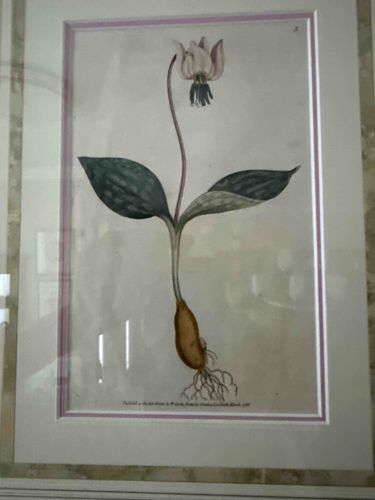
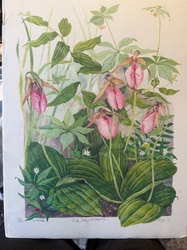
This item is a framed botanical illustration depicting a Dog's Tooth Violet, scientifically known as Erythronium dens-canis. The illustration is presented vertically, showcasing the entire plant from its underground bulbous root system to its delicate flower. The predominant colors in the illustration are shades of green for the broad, mottled leaves, a reddish-brown for the stem, a pale pink to almost white for the petals of the downward-facing flower, and a dark blue or purplish-black for the prominent anthers within the bloom. The root system features an elongated, tapered brown bulb resembling a dog's tooth, from which numerous fine, off-white rootlets extend.
The artwork is enclosed within a white matted frame with a thin, pale purple inner border, adding a subtle decorative touch. The outer frame appears to be a light-colored wood or composite material, possibly cream or very light beige, with a simple, clean profile. The illustration itself shows some light discoloration or foxing consistent with age, particularly visible in the lighter background areas, suggesting it could be an antique or vintage print. There are no obvious tears or significant damage visible to the artwork, although reflections on the glass make it difficult to assess the exact condition of the paper. A faint line of text is visible at the bottom of the illustration, likely containing the botanical name and possibly publication or artist details, but it is too indistinct to read precisely. The overall aesthetic suggests an 18th or 19th-century style of botanical rendering, characterized by scientific accuracy coupled with artistic elegance. The quality of line work and color application appears refined, indicative of a professional botanical artist or engraver.
AI Appraisal Report
I have thoroughly examined the provided image of the framed botanical illustration of Dog's Tooth Violet (Erythronium dens-canis) to provide an appraisal. My assessment indicates a value range of $300-500.
CONDITION AND AUTHENTICITY: The illustration appears to be a vintage or antique print, suggested by the visible light discoloration and foxing, consistent with age. Despite this, the print itself shows no obvious tears or significant damage, presenting well within its frame. The framing, with its white mat and thin pale purple inner border, along with a light-colored wood outer frame, is aesthetically pleasing and appears to protect the artwork adequately. Authenticity as an 18th or 19th-century botanical rendering is strongly suggested by the style, scientific accuracy, and artistic elegance. However, I must emphasize that this assessment is based solely on visual examination of the image. Reflections on the glass make it difficult to fully assess the paper's exact condition and the legibility of any text at the bottom.
MARKET CONDITIONS, DEMAND, AND RARITY: Botanical illustrations of this era are generally in demand, especially those depicting recognizable or aesthetically pleasing species. The scientific detail combined with artistic quality is a key driver for collectors. While not exceptionally rare, quality pieces from well-regarded botanical artists or publications retain good market value. Prices tend to be higher for hand-colored engravings or original watercolors versus later prints, but even good quality prints command interest.
FACTORS IMPACTING VALUE: The apparent age and good overall presentation in a suitable frame contribute positively to its value. The quality of the botanical rendering is high. The primary limitations are the inability to confirm if this is an original hand-colored engraving or a later print, and the exact condition of the paper beneath the glass. PROVENANCE/AUTHENTICATION: Full authentication would require in-person examination to assess paper quality, printing technique (e.g., intaglio, lithograph), the presence of platemarks, and precise identification of any maker's marks or publication details obscured or indistinct in the image. Scientific testing of paper and pigments could further confirm age. Documentation of provenance, if available, would significantly enhance its value and confirm authenticity.