AI Appraisal Estimate

AI-generated estimates · not official valuations

From the user

What was submitted

Photo and notes provided by the user — not generated by AI

Submitted item photo
Submitted photo · June 19, 2026

User's notes

No additional notes provided.

AI analysis below

AI appraisal

AI analysis & estimate

AI-Generated · Verify before acting

Everything below is generated by AI for informational purposes only. AI can make mistakes — the AI may misidentify items or misattribute them (artist, maker, brand, designer, origin, era). This is not an official valuation and should not be used for insurance, sale, tax, estate, legal, or lending purposes — or any decision requiring a certified appraisal. It is not an authoritative claim about any person, brand, or rights holder — do not share or rely on it as a factual statement about a third party. Always consult qualified professionals before making financial decisions.

Read the full disclaimer

AI Identification

·Not independently authenticated·Verify before acting

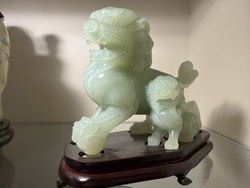
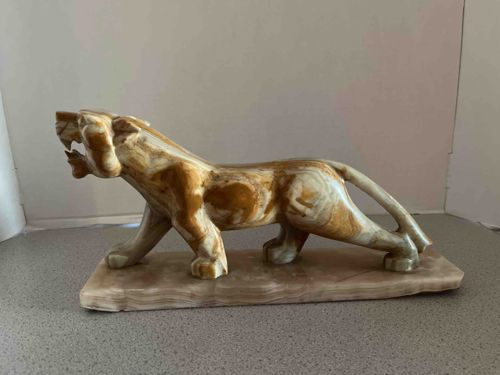
Carved Onyx or Tiger's Eye Alabaster Tiger Sculpture

Decorative Arts / Stone Sculptures

AI Estimated Value

·Not an official valuation·Verify before acting

$150 - $250

As of June 19, 2026

AI Item Analysis

·AI can make mistakes·Verify before acting
This is a hand-carved animal sculpture depicting a prowling tiger or stylized big cat, mounted on an integral rectangular stone base. The piece is crafted from a banded decorative stone, likely Mexican onyx, calcite, or a variety of banded alabaster, featuring a rich palette of caramel, honey-brown, and creamy white tones. The stone's natural striations are strategically utilized to mimic the striped patterns of a tiger. The sculpture shows a dynamic forward-leaning pose with an open mouth, displaying carved teeth and a roaring expression. In terms of construction, the figure appears to be a separate carving joined to a chiseled-edge base with similar banding. The carving style is somewhat folk-art or mid-century souvenir in nature, typical of stone workshops in regions like Mexico or Italy from the mid-to-late 20th century (circa 1950s-1970s). The surface has been polished to a high gloss, though there are visible natural fissures and some minor pitting inherent to the stone material. Condition appears generally good with no major structural fractures, although there is slight chipping or roughness visible on the lower edges of the base and around the tail area, possibly representing age-related wear or original crafting imperfections. No maker's marks or signatures are visible from this angle.
AI Appraisal Report

·AI can make mistakes·Verify before acting
I have examined the digital representation of this hand-carved banded onyx or calcite tiger sculpture. The piece appears to be a mid-20th-century decorative work, likely originating from a high-volume stone workshop in Mexico or Italy. The artisan skillfully utilized the natural 'tiger-stripe' banding of the mineral to enhance the subject matter. The dynamic, roaring pose and polished finish suggest a provenance as a high-quality souvenir or home decor item from the 1960s or 1970s. Condition-wise, the high-gloss polish remains largely intact, though I observed typical minor chipping along the raw-hewn edges of the base and natural fissures inherent to the stone. Market demand for these items is currently stable within the vintage 'Eclectic' and 'Mid-Century Modern' decorative markets. Comparables for smaller, unsigned stone tigers of this size and era consistently auction in the $150 to $250 range. Its value is driven primarily by aesthetic appeal rather than artist pedigree. Limitations: This appraisal is based solely on visual inspection of images. Without physical examination, I cannot definitively confirm the exact mineral species (e.g., differentiating between calcite-based onyx and alabaster) or verify the presence of adhesive repairs at the tail or legs which may be obscured by the stone’s heavy veining. A full authentication would require an in-person inspection to look for microscopic maker's marks, UV light testing for hidden restorations, and a hardness test to verify the stone type. Provenance documentation, such as original sales receipts, would further cement its historical context.

Get your items appraised

Instant estimates of your treasures with AI-powered appraisals

Browse More Appraisals