AI estimate as of August 17, 2025 · verify with a professional before acting
AI-Generated · Verify before acting
Everything on this page is generated by AI for informational purposes only. AI can make mistakes — the AI may misidentify items or misattribute them (artist, maker, brand, designer, origin, era). This is not an official valuation and should not be used for insurance, sale, tax, estate, legal, or lending purposes — or any decision requiring a certified appraisal. It is not an authoritative claim about any person, brand, or rights holder — do not share or rely on it as a factual statement about a third party. Always consult qualified professionals before making financial decisions.
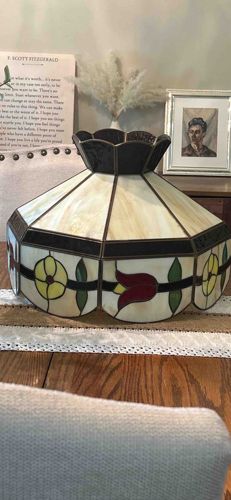
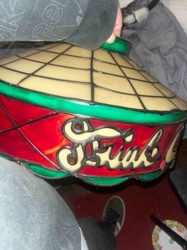
This is a decorative Tiffany-style stained glass lamp shade, likely intended for a table lamp or a hanging fixture. The shade features a multi-faceted, inverted hexagonal or octagonal shape, tapering slightly upwards to a scalloped opening. It is constructed from individual pieces of stained glass, joined together by dark-colored lead or copper foil solder lines. The predominant color of the main panels is an iridescent or mottled cream/off-white, which creates a soft, diffused light when illuminated. A decorative band encircles the lower section, featuring floral motifs. Specifically, there are yellow flowers with dark centers and green leaves, and alternating red tulip-like flowers with green leaves. The dark border at the top and bottom of this floral band, as well as the joining lines, indicates a traditional stained glass construction method. The upper portion, leading to the scalloped opening, appears to be made of a solid, dark, possibly metal or resin material, which is molded to mimic the facets of the glass. The craftsmanship appears to be reasonably good, with clean solder lines visible. There are no obvious signs of cracks or damage to the glass panels, nor significant corrosion or wear on the leading/solder. The overall condition appears to be good, with a visible, possibly intentional, patina on the metalwork that complements the antique aesthetic. This shade evokes the Art Nouveau or Mission style periods, popularized in the late 19th and early 20th centuries, though modern reproductions are common. Without maker's marks, precise age or origin is difficult to ascertain, but it is a classic design.
AI Appraisal Report
Upon examining the provided image of this Tiffany-style stained glass lamp shade, my assessment of its condition is quite positive. The glass panels appear intact with no visible cracks or damage. The solder lines are clean, suggesting competent craftsmanship, and there's no apparent corrosion or significant wear on the leading. The intentional patina on the metalwork enhances its aesthetic. However, based solely on the image, definitively verifying authenticity as an original Tiffany piece is impossible. This design evokes the Art Nouveau period, but without maker's marks, provenance documentation, or in-person technical examination (e.g., glass type analysis, solder composition, construction details consistent with known Tiffany methods), it's highly likely a well-made reproduction. True Tiffany lamps are exceedingly rare and command values in the five to six figures due to their historical significance, artistic mastery, and documented provenance. The current market for Tiffany-style reproductions varies widely based on quality, age, and size. While there is a consistent demand for attractive stained glass lighting, these are not rare. Factors significantly impacting value here are its condition (excellent), attractive design, and the quality of execution. However, its likely status as a reproduction limits its top-tier value severely. For full authentication, I would need to physically inspect the piece for subtle construction nuances, glass anomalies, and test for material compositions characteristic of period Tiffany studios. Provenance records are also crucial. Lacking these, its market value is based on its decorative appeal and functional quality as a reproduction.