AI estimate as of October 24, 2025 · verify with a professional before acting
AI-Generated · Verify before acting
Everything on this page is generated by AI for informational purposes only. AI can make mistakes — the AI may misidentify items or misattribute them (artist, maker, brand, designer, origin, era). This is not an official valuation and should not be used for insurance, sale, tax, estate, legal, or lending purposes — or any decision requiring a certified appraisal. It is not an authoritative claim about any person, brand, or rights holder — do not share or rely on it as a factual statement about a third party. Always consult qualified professionals before making financial decisions.
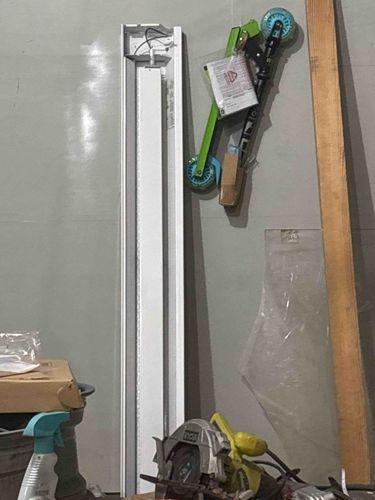
The item is a long, linear light fixture, most likely designed for fluorescent tubes or integrated LED strips. It appears to be constructed from white-painted or powder-coated metal, likely steel or aluminum, given its robust and industrial appearance. The fixture has a rectangular cross-section with an open channel for light distribution, and it is positioned vertically against a light gray wall. At the top end, internal wiring, consisting of black and white insulated wires, is visible, indicating it requires hardwiring for installation. The design suggests it is an unfinished or uninstalled unit, possibly new-old stock or recently purchased due to the absence of visible dirt, dust, or significant operational wear. The internal reflective or diffractive surface is visible, designed to maximize light output. There are no obvious dents, scratches, or significant cosmetic blemishes, suggesting it is in good to excellent condition. The overall aesthetic is functional and utilitarian, typical of commercial or workshop lighting. Its long, slender form factor indicates it's meant for overhead, wall, or under-cabinet mounting where continuous linear illumination is desired. Given the visible wiring, it does not appear to be a plug-and-play unit but rather intended for permanent electrical installation. The lack of diffusers or lamps within the channel suggests it might be sold as a bare fixture, with lamps or covers to be added separately, or that it is an integrated LED unit where the LEDs are embedded within the strip.
AI Appraisal Report
Upon visual examination of the provided image, I assess this Fluorescent or LED Strip Light Fixture to be in excellent, likely new or like-new, condition. The white finish appears unblemished, and there are no visible dents, scratches, or operational wear. The exposed internal wiring suggests it is an unfinished or uninstalled unit. Authenticity, in terms of brand or specific model, cannot be definitively determined from the image alone. This is a generic-looking fixture, commonly manufactured by many lighting companies.
Market conditions for this type of utilitarian light fixture are generally stable. Comparables would include similar bare fluorescent or integrated LED strip fixtures from manufacturers like Lithonia Lighting, Feit Electric, or generic brands found at hardware stores. Prices typically range from $20 to $70 depending on length, brand, and whether it's T8/T12 compatible or an integrated LED unit. Demand is consistent for residential garages, workshops, basements, and commercial utility areas. Rarity is not a factor here; these are mass-produced items.
Factors significantly impacting value include its length (which isn't fully ascertainable), whether it's designed for replaceable fluorescent tubes or has integrated LEDs (which often command a slightly higher price), and the quality of internal components (not visible). The lack of diffusers or lamps suggests it may be a bare fixture, which typically costs less than a complete, ready-to-install unit.
Limitations in authenticity verification are significant. Without a physical inspection, I cannot confirm the manufacturer, specific model number, materials beyond surface finish (e.g., gauge of steel/aluminum), electrical specifications, or the presence/absence of integrated LEDs. In-person examination would involve checking labels, material thickness, wiring quality, and testing functionality if possible. Provenance documentation (receipts, boxing) or scientific testing (material analysis) would be crucial for precise authentication of specific claims, but for a generic item like this, it's typically unnecessary.