These notes were written by the person who submitted this item. Appraiser.AI has not verified them, and the AI's identification and estimate may rely on them.
AI Estimated Value
Not an official valuation
$15-30
AI estimate as of November 4, 2025 · verify with a professional before acting
AI-Generated · Verify before acting
Everything on this page is generated by AI for informational purposes only. AI can make mistakes — the AI may misidentify items or misattribute them (artist, maker, brand, designer, origin, era). This is not an official valuation and should not be used for insurance, sale, tax, estate, legal, or lending purposes — or any decision requiring a certified appraisal. It is not an authoritative claim about any person, brand, or rights holder — do not share or rely on it as a factual statement about a third party. Always consult qualified professionals before making financial decisions.
This analysis also relies on unverified notes provided by the user, which may be incomplete or inaccurate and could affect the result.
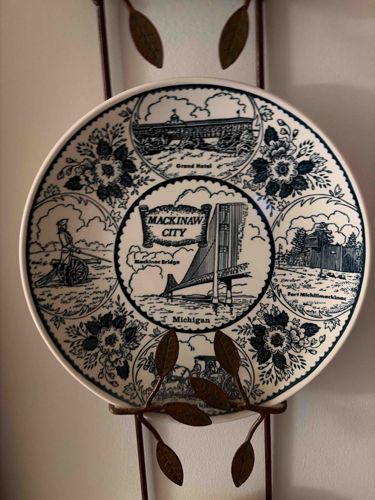
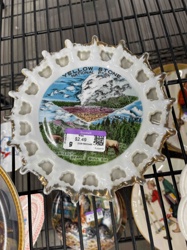
This is a circular decorative souvenir plate, likely made of ceramic or porcelain, featuring a detailed transferware design in a dark blue (cobalt or similar shade) on a white background. The plate's rim has a slightly scalloped or fluted edge, adding a classic touch. The central design element is a circular cartouche with the words "MACKINAW CITY" prominently displayed, below which is an illustration of the Mackinac Bridge, labeled "Mackinac Bridge," with "Michigan" written below it. Surrounding this central motif are several smaller vignettes, each depicting a recognizable landmark or scene from the Mackinaw City area. These include: 'Grand Hotel' at the top, 'Fort Michilimackinac' on the right, and another historical or scenic depiction on the left (possibly a cannon or a historical figure), and one at the bottom that is partially obscured but appears to be a natural or historical scene. These vignettes are separated by elaborate floral and leaf patterns, typical of traditional transferware. The overall aesthetic suggests a mid-20th century souvenir item. The plate appears to be in good condition with no obvious chips, cracks, or significant wear to the design. The dark blue coloration shows good saturation and definition throughout the intricate illustrations. The plate is displayed on a decorative metal stand with leaf accents, which is separate from the plate itself. No maker's marks are visible in the provided image.
AI Appraisal Report
Based on my visual examination of the provided image, this Mackinaw City souvenir plate is a charming example of transferware, likely ceramic or porcelain. The condition appears to be very good; I observe no obvious chips, cracks, or significant wear to the dark blue (cobalt) design. The scalloped rim and intricate vignettes, including the Mackinac Bridge, Grand Hotel, and Fort Michilimackinac, are well-defined, suggesting careful handling over time. The overall aesthetic strongly points to a mid-20th century production.
Authenticity, as a souvenir item, is less about a specific manufacturer and more about its representation. This item is certainly authentic to its purpose as a souvenir. However, without physical examination, I cannot verify the exact material (ceramic vs. porcelain), the specific transferware technique, or detect hairline cracks, crazing, or repairs that might not be visible in the photograph. Maker's marks, which are not visible, would aid in dating and attribution if present.
Market conditions for souvenir plates of this nature are generally modest. While it holds sentimental and historical interest, demand is typically driven by niche collectors of Michigan memorabilia or vintage Americana. Rarity is not a significant factor; these plates were produced in quantity. Comparables for similar regional souvenir plates from the mid-20th century typically range from $10 to $40, depending on condition, design appeal, and specific location represented. The decorative stand is separate and does not add significant value to the plate itself.
Factors impacting value include its excellent apparent condition and the detailed, appealing design. However, the lack of significant age, rarity, or association with a prominent manufacturer keeps the value in the collectible rather than antique range. An in-person inspection would allow for tapping, magnification, and blacklight examination to definitively assess material, surface integrity, and detect any potential restoration or hidden flaws. Provenance documentation, while unlikely for such an item, could also add minor historical context.