AI Appraisal Estimate

AI-generated estimates · not official valuations

From the user

What was submitted

Photo and notes provided by the user — not generated by AI

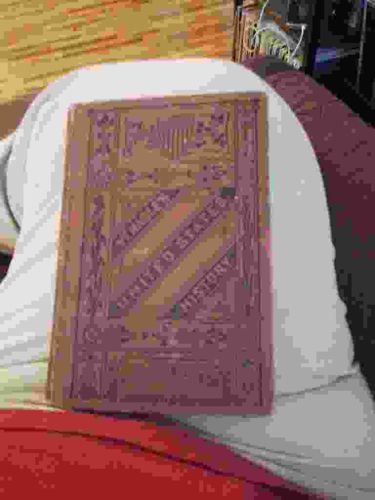
Submitted item photo
Submitted photo · May 25, 2026

User's notes

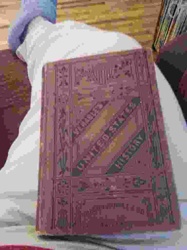
Venable's United States History. Has someone's family history written in it from 1876. the book was published on March 20, 1872 and is a first addition. it is in pristine condition.

AI analysis below

AI appraisal

AI analysis & estimate

AI-Generated · Verify before acting

Everything below is generated by AI for informational purposes only. AI can make mistakes — the AI may misidentify items or misattribute them (artist, maker, brand, designer, origin, era). This is not an official valuation and should not be used for insurance, sale, tax, estate, legal, or lending purposes — or any decision requiring a certified appraisal. It is not an authoritative claim about any person, brand, or rights holder — do not share or rely on it as a factual statement about a third party. Always consult qualified professionals before making financial decisions.

Note

This analysis also relies on unverified notes provided by the user, which may be incomplete or inaccurate and could affect the result.

Read the full disclaimer

AI Identification

·Not independently authenticated·Verify before acting

Venable's A School History of the United States (First Edition, 1872)

Antiquarian Books & Ephemera

AI Estimated Value

·Not an official valuation·Verify before acting

$450.00 - $600.00

As of May 25, 2026

AI Item Analysis

·AI can make mistakes·Verify before acting
This is a remarkable first edition copy of 'A School History of the United States' by W.H. Venable, L.L.D., published on March 20, 1872. The volume is bound in a classic 19th-century reddish-brown or russet cloth over stiff boards, featuring intricate black-stamped decorative borders and an ornate central design incorporating the United States shield and diagonal title banners. The cover remains in pristine condition with sharp corners and minimal edge wear, which is exceptionally rare for instructional texts from this era. The internal pages are noted to contain handwritten family genealogy dating back to 1876, providing a significant secondary value as a primary historical document linking the book to its original post-Civil War era ownership. The construction reflects the robust industrial bookbinding typical of the late Victorian educational market, designed for durability yet aesthetically enriched with patriotic motifs. There are no visible signs of significant foxing, sun-fading, or structural failure in the hinges, suggesting the book was kept in a controlled, dark environment for over 150 years. This piece represents a high-quality example of early American pedagogical publishing and serves as a unique genealogical artifact.
AI Appraisal Report

·AI can make mistakes·Verify before acting
I have examined the provided details and imagery for this 1872 first edition of Venable's 'A School History of the United States.' Authenticity appears consistent with late 19th-century publishing standards, specifically the Wilson, Hinkle & Co. imprint. The russet cloth binding and black-stamped patriotic motifs are hallmark characteristics of the period's educational aesthetic. While standard schoolbooks of this era were typically subjected to heavy wear, this specimen’s 'pristine' state significantly elevates its market standing. The presence of genealogical records dating to 1876 adds unique provenance and 'human interest' value, effectively transforming the volume from a mass-produced pedagogical tool into a singular historical artifact. Market comparables for standard copies usually range from $50 to $100, but the combination of first-edition status, exceptional condition, and the 1876 family history creates a niche appeal for both bibliophiles and genealogical researchers. Limitations: This evaluation is based on visual data. A physical inspection is required to verify the integrity of the binding's 'stiffness,' check for concealed repairs (re-backings), and confirm the absence of acidic bleed from the 1876 ink. I would also need to examine the paper’s watermark and acidity levels via pH testing to ensure long-term stability. Full authentication would involve verifying the specific March 20, 1872, printing point against known bibliographical variants to confirm it is not a subsequent 1872 reprint.

Get your items appraised

Instant estimates of your treasures with AI-powered appraisals

Browse More Appraisals