AI estimate as of August 25, 2026 · verify with a professional before acting
AI-Generated · Verify before acting
Everything on this page is generated by AI for informational purposes only. AI can make mistakes — the AI may misidentify items or misattribute them (artist, maker, brand, designer, origin, era). This is not an official valuation and should not be used for insurance, sale, tax, estate, legal, or lending purposes — or any decision requiring a certified appraisal. It is not an authoritative claim about any person, brand, or rights holder — do not share or rely on it as a factual statement about a third party. Always consult qualified professionals before making financial decisions.
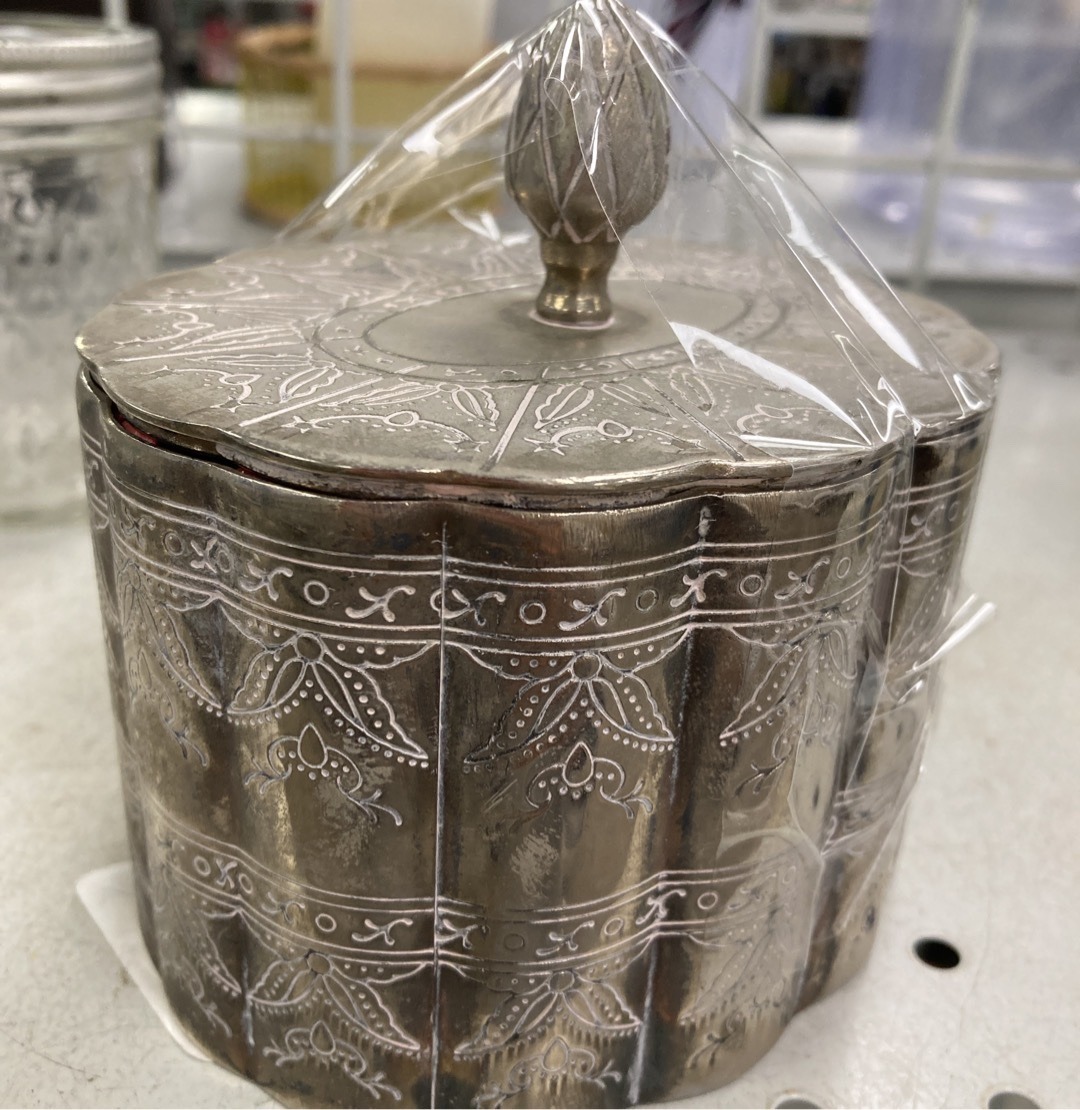
This is a cylindrical decorative lidded box featuring a distinct paneled or fluted construction along its body. The piece has a metallic appearance with a dark, muted silver or pewter tone, accented by white or light-colored recessed etched detailing. The surface is elaborately decorated with repeating engraved patterns, including bands of stylized floral, foliate, and geometric motifs running horizontally around the body, as well as radiating patterns on the flat top of the lid. The lid is surmounted by a prominent, faceted, bud-shaped or acorn-shaped finial set on a circular base plate. The object is partially wrapped in a clear plastic film. There are visible surface variations, tarnishing, and wear to the metallic finish, suggesting age or handling. No maker's marks, hallmarks, or signatures are clearly visible in the provided image. The overall craftsmanship and decorative style suggest a mid-to-late 20th-century decorative accessory, possibly of Middle Eastern, Indian, or Continental European manufacture, though this is purely stylistic speculation and remains unverified.
AI Appraisal Report
Based on what I can see in the image, this cylindrical decorative lidded box features a muted silver-tone metallic finish with intricate etched floral, foliate, and geometric motifs, along with a prominent faceted finial. I cannot verify the exact metal composition, age, or precise geographic origin from a photograph alone; physical inspection, hallmark verification, and expert appraisal would be needed to confirm these details. The aesthetic suggests a mid-to-late 20th-century decorative accessory, potentially of Middle Eastern, Indian, or Continental European manufacture, though this attribution remains speculative. The surface shows visible tarnish, wear, and partial wrapping in plastic, which factor into the current condition assessment. General market demand for decorative metalware of this type is modest, typically driven by interior decorators and collectors of ethnic or vintage decorative objects rather than high-end art market participants. The estimated value range provided assumes the stylistic attribution is correct. However, if the item turns out to be a modern reproduction, replica, or made strictly 'in the style of' rather than a period piece, the value would likely drop to the $30-$75 range. To establish a more precise value and ensure authenticity, physical examination, checking for hidden maker's marks, and potential metallurgical testing would be required.