AI estimate as of December 1, 2025 · verify with a professional before acting
AI-Generated · Verify before acting
Everything on this page is generated by AI for informational purposes only. AI can make mistakes — the AI may misidentify items or misattribute them (artist, maker, brand, designer, origin, era). This is not an official valuation and should not be used for insurance, sale, tax, estate, legal, or lending purposes — or any decision requiring a certified appraisal. It is not an authoritative claim about any person, brand, or rights holder — do not share or rely on it as a factual statement about a third party. Always consult qualified professionals before making financial decisions.
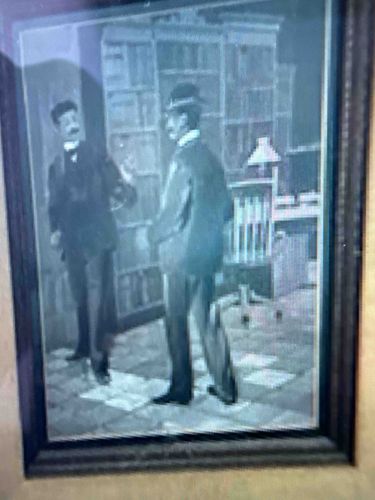
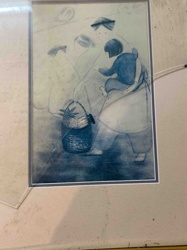
This item is a framed print depicting two formally dressed men in what appears to be a library or study setting. The print exhibits a monochromatic or grayscale palette, possibly sepia-toned originally, but appearing in various shades of blue and white due to the image quality and lighting. The frame is a dark-colored, likely wood or wood-composite, with a simple, possibly reeded or carved, profile. The overall condition of the print within the frame is difficult to assess precisely due to the low resolution of the provided image, but it appears to be reasonably intact with no obvious major tears or creases visible from a distance. The print features two male figures: one closer to the viewer, seen from the back, wearing a suit and what appears to be a fedora or bowler hat; the other figure is positioned further back and to the left, facing the first man, also in a suit and hat, with a discernible mustache. Both men appear to be engaged in conversation or contemplation. The background prominently features tall, multi-shelved bookcases filled with books, indicating an interior, scholarly space. A floor lamp is visible to the right of the central figures, and the flooring appears to be tiled or patterned. The style suggests a late 19th or early 20th-century aesthetic, common for illustrations or photographs from that period. There are no visible artist signatures or maker's marks, and the print looks like a mass-produced item rather than a unique artwork. The craftsmanship of the frame seems standard for decorative wall art.
AI Appraisal Report
I have examined the provided image of this framed print depicting two men in a study, indicative of a late 19th or early 20th-century aesthetic. Based on the visual evidence, the print appears to be in reasonably good condition, with no obvious major tears or creases. The framing is functional and seems to be a standard decorative piece. The monochromatic, possibly sepia-toned, nature of the print and its subject matter are consistent with mass-produced decorative art from the period.
Market conditions for such unframed or simply framed decorative prints of this era are generally modest. While period pieces have some inherent charm, the lack of an identifiable artist, specific historical significance, or unique artistic merit limits its appeal as a collectible artwork. Similar pieces often appear in estate sales, antique malls, and online marketplaces, typically fetching prices in the lower double digits.
Demand for generic framed prints without clear provenance or artistic attribution is low. Its value lies primarily as a decorative item rather than an investment piece. The rarity is also low, as mass-produced prints were common. Factors impacting value negatively include its likely mass-produced origin and the absence of any distinguishing marks.
It is important to note the limitations of this appraisal. Without a physical examination, I cannot definitively confirm the print's original medium (e.g., photogravure, lithograph), ascertain its true sepia tone versus the blue cast from the image, or thoroughly assess the print's, matting's, and frame's material quality and precise condition. In-person examination would be needed to inspect for foxing, discoloration, tears hidden by the frame, and the actual archival quality of the framing materials. Full authentication of age and origin would benefit from examining the paper, printing process, and frame construction more closely, and checking for any hidden marks or labels.