These notes were written by the person who submitted this item. Appraiser.AI has not verified them, and the AI's identification and estimate may rely on them.
AI Estimated Value
Not an official valuation
$40-80
AI estimate as of December 10, 2025 · verify with a professional before acting
AI-Generated · Verify before acting
Everything on this page is generated by AI for informational purposes only. AI can make mistakes — the AI may misidentify items or misattribute them (artist, maker, brand, designer, origin, era). This is not an official valuation and should not be used for insurance, sale, tax, estate, legal, or lending purposes — or any decision requiring a certified appraisal. It is not an authoritative claim about any person, brand, or rights holder — do not share or rely on it as a factual statement about a third party. Always consult qualified professionals before making financial decisions.
This analysis also relies on unverified notes provided by the user, which may be incomplete or inaccurate and could affect the result.
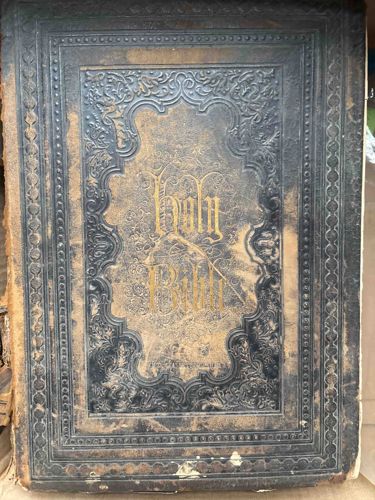
This item is an antique or vintage bound book, specifically identified as a Bible attributed to Rev. John Brown, D.D. The cover features a dark, likely leather or faux leather material, heavily embossed and decorated. The central panel is lighter, possibly a distressed gold or tan color, on which the word "Holy" and "Bible" are prominently debossed and gilded in a gothic script. The surrounding frame on the cover is intricately decorated with a repetitive pattern of floral or acanthus leaf motifs, deeply impressed into the material. This ornate border is enclosed by a series of concentric rectangular lines, some dotted, adding to the opulent aesthetic. The overall impression is one of elaborate, late 19th or early 20th-century design. Visible condition issues include significant wear and tear, particularly along the edges and corners where the dark outer layer has rubbed away, revealing lighter material underneath. There are also scuff marks and discoloration across the central panel and the embossed borders, indicative of age and extensive handling. The spine, partially visible on the left, appears to be heavily damaged or detached, suggesting a fragile binding. This deterioration is consistent with an item of considerable age that has not undergone professional restoration. The craftsmanship, though showing signs of age, indicates a high level of detail in the embossing and gilding, suggesting it was a premium edition in its time. The deep relief of the patterns and the gold lettering are hallmarks of quality bookbinding from that era.
AI Appraisal Report
Based on my visual examination of the provided image, this Rev. John Brown, D.D. Bible appears to be a late 19th or early 20th-century family Bible. The elaborate embossed and gilded cover, with prominent 'Holy Bible' lettering in gothic script surrounded by intricate floral or acanthus leaf motifs, is characteristic of Bibles produced during this period. The craftsmanship of the deep relief and gilding suggests it was a premium edition at the time of its manufacture.
The condition, however, significantly impacts its value. I observe considerable wear and tear across the cover, particularly along the edges and corners where the dark outer layer has worn away, revealing lighter material beneath. Scuff marks, discoloration, and what appears to be a heavily damaged or detached spine further attest to its fragile state and extensive handling. These condition issues are consistent with an antique item that has not been professionally preserved or restored.
Market conditions for such Bibles are generally moderate. While Bibles by Rev. John Brown are historically significant, this particular style of ornate family Bible is not exceedingly rare, especially when in poor condition. Comparables in similar deteriorated states typically fetch lower prices. Demand is primarily from collectors of antique Bibles, religious artifacts, or those with a personal connection to the specific author or period.
Factors significantly impacting value upwards would be a pristine condition, a historically significant provenance, or unique binding features not visible here. Downwards, the extensive physical damage, especially to the binding, is the primary detractor. Without in-person examination, I cannot verify the completeness of the text, presence of internal illustrations, or any personal inscriptions, which can sometimes add unique value. Full authentication of its specific edition and true printing date would require physical inspection of the title page and collation against known bibliographies.