AI estimate as of September 24, 2025 · verify with a professional before acting
AI-Generated · Verify before acting
Everything on this page is generated by AI for informational purposes only. AI can make mistakes — the AI may misidentify items or misattribute them (artist, maker, brand, designer, origin, era). This is not an official valuation and should not be used for insurance, sale, tax, estate, legal, or lending purposes — or any decision requiring a certified appraisal. It is not an authoritative claim about any person, brand, or rights holder — do not share or rely on it as a factual statement about a third party. Always consult qualified professionals before making financial decisions.
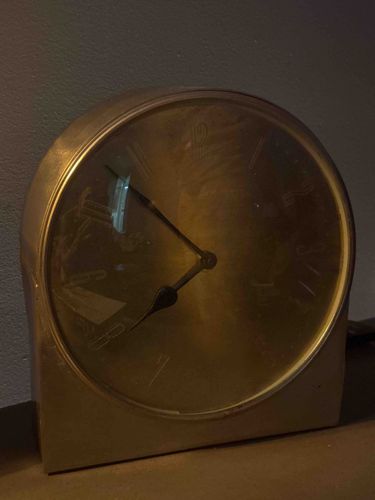
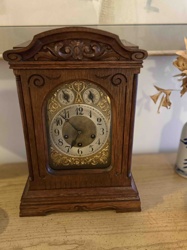
This is an Art Deco style mantle clock, likely dating from the 1920s to 1940s, characterized by its streamlined, geometric form. The clock features a brass or brass-plated metal case with a distinctive D-shaped or arched top and a flat base, presenting a robust and substantial appearance. The overall color is a warm, aged gold or bronze, indicative of a natural patina that has developed over time, adding to its antique appeal. The clock face is integrated seamlessly into the case, also appearing to be brass or bronze with a brushed finish. Time is indicated by black Roman numerals, which appear to be etched or applied in a simple sans-serif font, contributing to the Art Deco aesthetic. Some numerals, specifically 'X' (10) and 'XI' (11), are faintly visible in the upper left quadrant. The hour and minute hands are black, spade-shaped, or stylized arrow hands, consistent with the period and designed for clear legibility against the metallic face. There appears to be no second hand. The crystal covering the clock face is subtly curved, following the contours of the case. Visible condition issues include surface wear and light scratches on the metallic finish, particularly around the face, likely from handling and age. There are no obvious dents or significant damage, suggesting it has been relatively well-preserved. Reflections on the surface make it difficult to discern all markings clearly, but no prominent maker's marks or signatures are immediately apparent. The craftsmanship appears solid and functional, prioritizing form and material over elaborate ornamentation, which is characteristic of the Art Deco movement. Its substantial construction suggests it was a quality item in its time, intended for a prominent display on a mantle or shelf.
AI Appraisal Report
Based on my visual examination of the provided image, this Art Deco mantle clock appears to be a genuine piece from the 1920s-1940s, aligning with the described characteristics of the period. The streamlined geometric form, brass or brass-plated case with a D-shaped top, and absence of elaborate ornamentation are all consistent with Art Deco design principles. The natural patina visible suggests age-appropriate wear and adds to its authenticity. The condition appears good for its age, with expected surface wear and light scratches but no apparent significant damage. This indicates it has been relatively well-preserved.
Market conditions for Art Deco mantle clocks are generally steady. Comparable pieces of this quality, particularly those without prominent maker's marks or highly intricate designs, typically fall within the mid-range. Demand exists, but true rarity is usually reserved for clocks by renowned makers or those with exceptional design and pristine condition. This piece, while solid and attractive, does not present as exceptionally rare.
Factors impacting value include its good overall condition, authentic Art Deco styling, and substantial construction. The absence of a visible maker's mark significantly impacts the high-end potential of its value. Without knowing the manufacturer, it's difficult to ascertain its original quality ranking. Its mechanical functionality – whether it runs and keeps accurate time – is also a major value determinant not discernible from the image alone.
It is crucial to note the limitations of remote appraisal. While the visual indicators are strong, an in-person examination would be necessary to confirm the material composition (solid brass versus plating), inspect the movement for originality and working condition, and scrutinize for subtle repairs or restorations not visible in the photograph. Physical testing of the mechanism and a thorough search for any hidden maker's marks or serial numbers would provide a more definitive authentication and inform a more precise valuation.