AI estimate as of September 28, 2025 · verify with a professional before acting
AI-Generated · Verify before acting
Everything on this page is generated by AI for informational purposes only. AI can make mistakes — the AI may misidentify items or misattribute them (artist, maker, brand, designer, origin, era). This is not an official valuation and should not be used for insurance, sale, tax, estate, legal, or lending purposes — or any decision requiring a certified appraisal. It is not an authoritative claim about any person, brand, or rights holder — do not share or rely on it as a factual statement about a third party. Always consult qualified professionals before making financial decisions.
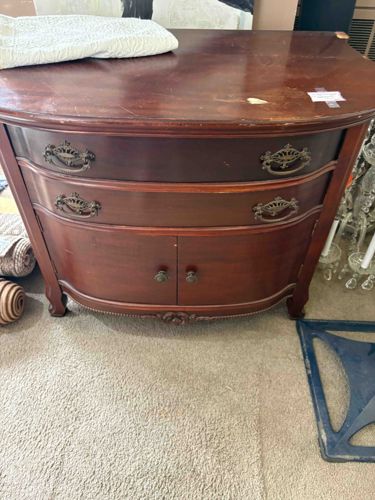
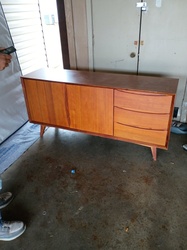
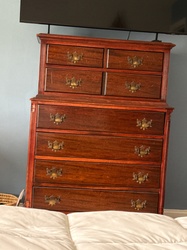
This is a serpentine front bureau, constructed primarily of wood, likely a mahogany or cherry, given its rich reddish-brown stain and visible grain. The top surface is semi-circular or D-shaped (when viewed from above) and features a noticeable amount of wear, including scratches, scuffs, and several areas where the finish has lifted or chipped off, exposing lighter wood underneath. There are also what appear to be adhesive residues or old labels on the top surface. The main body of the bureau presents a classic serpentine or bowed-front profile, with two drawers stacked above a two-door cabinet. The drawers are fitted with ornate, possibly brass or bronze-finished, swing bail pulls featuring decorative backplates characteristic of traditional or classical furniture styles. The drawer fronts also follow the curved contour of the piece. Below the drawers, a two-door cabinet features simpler, round knob pulls, suggesting a slightly less prominent design for this lower section. The cabinet doors appear to be flush with the frame. The base of the bureau has a carved or molded trim along the bottom edge, terminating in what appear to be modest cabriole or spade feet, providing a slight elevation. The overall style suggests a mid-20th century production, possibly a reproduction of an 18th or 19th-century Federalist or Chippendale style. The craftsmanship, while appearing solid, shows signs of extensive use and age, with the finish damage being a prominent condition issue that would require restoration to return it to pristine condition. The wood grain is visible through the stain, indicating a solid wood construction or at least a high-quality veneer.
AI Appraisal Report
Upon examining the provided image of this serpentine front bureau, I assess its condition as fair to poor. The extensive wear, particularly on the D-shaped top surface with significant scratches, scuffs, finish loss, and adhesive residue, is a major detractor. While the serpentine form, bail pulls, and overall design suggest a reproduction of 18th or 19th-century Federalist or Chippendale styles, likely mid-20th century, the finish damage indicates a need for substantial restoration. The visible wood grain suggests solid wood or high-quality veneer construction, which is a positive, but the current state significantly impacts its immediate aesthetic and functional value.
Market conditions for mid-20th century reproductions, especially those requiring restoration, are generally soft. While classical styles maintain some appeal, the cost of professional refinishing often outweighs the market value of the restored piece unless the craftsmanship is exceptionally high or the piece has unique design elements. Comparables in similar condition tend to fetch lower prices, often purchased by individuals seeking a project piece. Demand for such items is moderate, primarily from decorators or individuals on a budget willing to undertake restoration themselves. Rarity is not a significant factor here, as numerous such reproductions were manufactured.
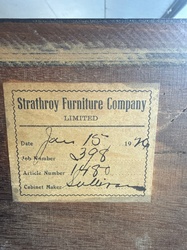
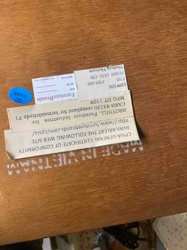
The primary factor impacting value is its poor finish condition, which necessitates costly restoration. Without in-person examination, I cannot definitively confirm the wood type (mahogany vs. cherry), verify construction methods (solid vs. veneer throughout), or identify any maker's marks that could indicate a higher-quality manufacturer. Provenance documentation could potentially elevate value if it traces back to a significant period or owner, but this is unlikely for a piece of this type. Scientific testing would be needed to confirm wood species and finish composition, though typically not warranted for items in this price range.