AI estimate as of July 26, 2025 · verify with a professional before acting
AI-Generated · Verify before acting
Everything on this page is generated by AI for informational purposes only. AI can make mistakes — the AI may misidentify items or misattribute them (artist, maker, brand, designer, origin, era). This is not an official valuation and should not be used for insurance, sale, tax, estate, legal, or lending purposes — or any decision requiring a certified appraisal. It is not an authoritative claim about any person, brand, or rights holder — do not share or rely on it as a factual statement about a third party. Always consult qualified professionals before making financial decisions.
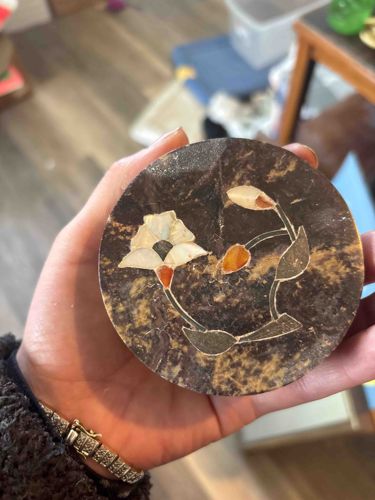
This item is a circular, flat object, likely a lid or a coaster, crafted from a dark, mottled stone, possibly marble or soapstone, exhibiting natural variations of deep brown, grey, and ochre hues. The surface is adorned with an intricate floral inlay design, featuring what appears to be two distinct flowers with accompanying foliage. One prominent flower, toward the left, has multiple petals made from an opaque, off-white or cream-colored material, possibly mother-of-pearl or another shell, highlighted with a central black or very dark inlay, and an orange or reddish accent at the base of its stem. The stem and leaves for this flower are rendered in a light grey or silvery material. To the right, a second floral element depicts a less open bloom, possibly a bud, with petals of a slightly translucent, off-white or pale orange material, and additional leaves and stem in the same light grey material. The inlay work appears to be flush with the stone surface, indicating a skilled craftsmanship. The overall diameter of the piece can be estimated as approximately 4-5 inches given its scale in the human hand. The stone itself shows a polished finish, though some minor surface wear or light scratching may be present, consistent with age and handling. There are no discernible maker's marks or signatures visible from the image. The style suggests a decorative piece from the mid-20th century or later, common in global artisan markets, particularly from regions with rich traditions in stone carving and inlay, such as India or Italy. The quality of the inlay seems good, with precise cuts and a tight fit, indicating attention to detail.
AI Appraisal Report
Upon visual examination of this decorative inlaid stone object, likely a lid or coaster, I have assessed its characteristics to determine a fair market value. The piece is crafted from a dark, polished stone, possibly marble, and features an intricate floral inlay. The craftsmanship appears competent; the inlaid elements, which seem to be mother-of-pearl, shell, or composite materials, are precisely cut and set flush with the stone surface. The design, depicting a main flower and a smaller bud, is aesthetically pleasing and typical of decorative items produced in regions like India, known for this type of pietra dura work. Based on the style and materials, I would date this piece to the latter half of the 20th century.
The condition appears good, with only minor surface wear consistent with age and use. There are no visible chips or significant losses to the inlay. The market for such decorative objects is generally stable but modest. Similar mass-produced, high-quality decorative stone coasters and small plates from artisan markets currently sell for between $20 and $60. The value is primarily driven by its decorative quality rather than rarity or historical significance. Without a maker's mark or provenance, it is considered a well-made decorative craft item. A definitive authentication would require physical inspection to identify the specific stone and inlay materials (e.g., distinguishing natural shell from plastic resin) and to check for any maker's marks or labels on the reverse or underside. However, such findings are unlikely to alter the value significantly unless it was discovered to be the work of a renowned studio.