AI Appraisal Estimate

AI-generated estimates · not official valuations

From the user

What was submitted

Photo and notes provided by the user — not generated by AI

Submitted item photo
Submitted photo · June 19, 2026

User's notes

Myrano

AI analysis below

AI appraisal

AI analysis & estimate

AI-Generated · Verify before acting

Everything below is generated by AI for informational purposes only. AI can make mistakes — the AI may misidentify items or misattribute them (artist, maker, brand, designer, origin, era). This is not an official valuation and should not be used for insurance, sale, tax, estate, legal, or lending purposes — or any decision requiring a certified appraisal. It is not an authoritative claim about any person, brand, or rights holder — do not share or rely on it as a factual statement about a third party. Always consult qualified professionals before making financial decisions.

Note

This analysis also relies on unverified notes provided by the user, which may be incomplete or inaccurate and could affect the result.

Read the full disclaimer

AI Identification

·Not independently authenticated·Verify before acting

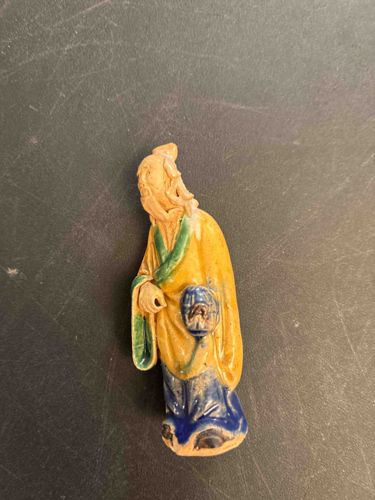
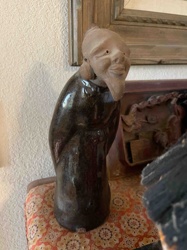
Chinese Shiwan Sancai Glazed Mud Man Figurine

Asian Antiques / Collectible Ceramics

AI Estimated Value

·Not an official valuation·Verify before acting

$45 - $80

As of June 19, 2026

AI Item Analysis

·AI can make mistakes·Verify before acting
This is a vintage hand-crafted ceramic figurine of an elderly Chinese sage or immortal, commonly referred to as a 'Mud Man.' The figure is constructed from a buff-colored clay base and features the classic Sancai (three-color) tri-color glaze palette of mustard yellow, deep emerald green, and cobalt blue. Characteristically for the Shiwan style, the face, beard, and hands remain unglazed to showcase the fine terracotta or stoneware detail. The figure is depicted in a traditional scholarly robe with flowing sleeves and a tall top-knot hairstyle. Notable craftsmanship is visible in the expressive, hand-tooled facial features and the detailed draping of the ceramic fabric. The glaze exhibits fine crazing throughout, which is consistent with age and intentional kiln cooling processes. Regarding condition, the piece shows surface wear and minor glaze thinning on high-relief edges, but no significant chips or structural cracks are immediately visible. These figures typically date from the late 19th century to the mid-20th century (Republic period), though this specific style remained popular for export throughout the 1900s. The 'Myrano' context provided likely refers to a distributor or a misremembered brand associated with the item's previous retail history.
AI Appraisal Report

·AI can make mistakes·Verify before acting
Based on my visual examination of this vintage Shiwan figurine, I identify it as a classic 'Mud Man' likely produced in the Canton province of China during the mid-20th century, typically falling within the Republic period or slightly later export era (c. 1920s-1950s). The piece exhibits the characteristic traits of Shiwan ware: a buff stoneware body with unglazed flesh tones and a thick, pooled Sancai-style drip glaze in emerald green, mustard yellow, and cobalt blue. The mention of 'Myrano' likely refers merely to an import label or retailer, which is common for export wares but does not significantly elevate the intrinsic value of the piece itself. The condition appears generally good for its age, with the expected crazing in the glaze which adds character. The modeling of the face and beard shows competent hand-tooling, capturing the wise, expressive nature of the sage figure. However, without a physical inspection, I cannot check for professional restorations on the fingers or beard tips—areas notoriously prone to undetectable repairs. In the current market, Shiwan Mud Men are collectible but abundant. While highly detailed, large antique examples can command hundreds of dollars, this specific figure appears to be a standard export model of moderate size. The market for mid-century export ceramics is stable but not aggressive. To verify a higher valuation, I would need to inspect the underside for specific impressed kiln marks (like 'CHINA' or specific workshop stamps) and confirm the absence of hairline cracks under UV light. Currently, it stands as a charming decorative example of Chinese folk art.

Get your items appraised

Instant estimates of your treasures with AI-powered appraisals

Browse More Appraisals