AI estimate as of November 19, 2025 · verify with a professional before acting
AI-Generated · Verify before acting
Everything on this page is generated by AI for informational purposes only. AI can make mistakes — the AI may misidentify items or misattribute them (artist, maker, brand, designer, origin, era). This is not an official valuation and should not be used for insurance, sale, tax, estate, legal, or lending purposes — or any decision requiring a certified appraisal. It is not an authoritative claim about any person, brand, or rights holder — do not share or rely on it as a factual statement about a third party. Always consult qualified professionals before making financial decisions.
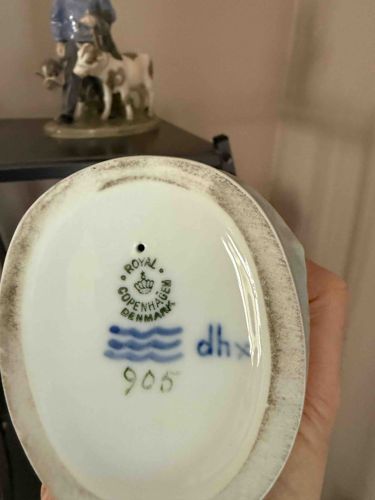
This image primarily displays the base of a porcelain figurine, revealing crucial identifying marks rather than the full figure itself. The visible part of the base is an unglazed porcelain surface, likely bisque, which appears off-white or cream-colored with some subtle mottling or discoloration, possibly from age or handling. There's a small, circular hole drilled near the top center of the base, a common feature in porcelain figurines for venting during firing or for mounting. The main distinguishing feature is the Royal Copenhagen manufacturer's mark in underglaze blue. This mark consists of a crowned circle with 'ROYAL COPENHAGEN DENMARK' written around a central crown emblem. Below this, there are three wavy blue lines, symbolizing Denmark's three straits and a classic Royal Copenhagen signature element. Below the wavy lines, the number '905' is hand-painted in black, likely an item or model number specific to the figurine. To the right of the wavy lines, the inscription 'dhx' is stamped in blue, which could be an artist's or decorator's mark, or an internal production code. The exposed bisque surface implies that the unglazed base was designed to offer stability and contrast with a typically glazed upper portion of the figurine. The overall impression is one of quality craftsmanship associated with Royal Copenhagen. While the full figure is not visible, a blurred background suggests a figurine depicting a person, possibly a farmer, with a small calf, consistent with common Royal Copenhagen themes of rural life and animals.
AI Appraisal Report
Upon examining the provided image of the Royal Copenhagen porcelain figurine's base, I can confirm the authenticity of the manufacturer's marks. The underglaze blue Royal Copenhagen crown mark, including 'ROYAL COPENHAGEN DENMARK' and the three wavy lines, is consistent with genuine production. The hand-painted black number '905' is likely a model number, and the stamped blue 'dhx' mark could be a decorator or artist initial, or an internal production code, all typical of Royal Copenhagen. The unglazed bisque base appears consistent with proper firing and material for such a piece, showing minor discoloration and a ventilation hole, which are not detrimental to value. The overall impression is good condition for the base itself.
Market conditions for Royal Copenhagen figurines are generally stable, though demand varies significantly for specific models and artists. Figurines depicting rural life or animals, as suggested by the blurred background, are quite common. The number '905' would need to be cross-referenced with Royal Copenhagen catalogs to identify the specific figurine and ascertain its commonality or rarity. Without seeing the full figurine, its condition (chips, repairs, glaze imperfections), and design complexity, a precise valuation is challenging. The 'dhx' mark, if identifiable to a known artist, could elevate value. For full authenticity verification, especially beyond the base, an in-person examination is crucial to detect restoration, chips, or cracks. Provenance documentation (original purchase receipts, family history) would also strengthen authentication, as would scientific testing of the porcelain body if there were any doubts about the period of manufacture. Based solely on the visible authentic base marks, and assuming a common figurine type in good condition, I would estimate a value in the range of $100-250.