AI Appraisal Estimate

AI-generated estimates · not official valuations

From the user

What was submitted

Photo and notes provided by the user — not generated by AI

Submitted item photo
Submitted photo · June 6, 2026

User's notes

No additional notes provided.

AI analysis below

AI appraisal

AI analysis & estimate

AI-Generated · Verify before acting

Everything below is generated by AI for informational purposes only. AI can make mistakes — the AI may misidentify items or misattribute them (artist, maker, brand, designer, origin, era). This is not an official valuation and should not be used for insurance, sale, tax, estate, legal, or lending purposes — or any decision requiring a certified appraisal. It is not an authoritative claim about any person, brand, or rights holder — do not share or rely on it as a factual statement about a third party. Always consult qualified professionals before making financial decisions.

Read the full disclaimer

AI Identification

·Not independently authenticated·Verify before acting

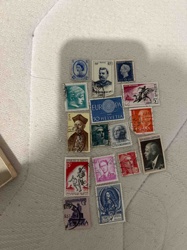
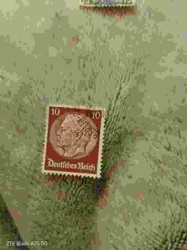
Collection of Late 19th and Early 20th Century German Philatelic Issues

Philately / Postage Stamps

AI Estimated Value

·Not an official valuation·Verify before acting

$45.00 - $75.00

As of June 6, 2026

AI Item Analysis

·AI can make mistakes·Verify before acting
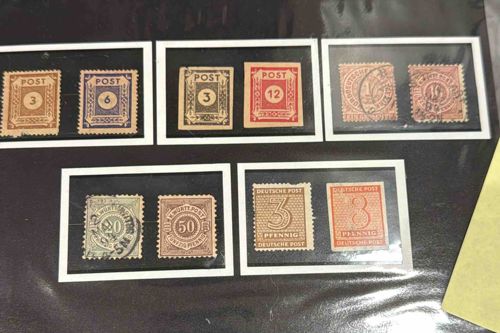
A collection of ten antique German postage stamps, featuring issues from the North German Confederation, Wuerttemberg, and early German Reich periods. The top row includes several definitive issues of the North German Confederation (Norddeutscher Postbezirk) circa 1869, characterized by their rectangular design with a central numeral in a circle and the word 'POST' at the top. Moving to the lower left, there are two Wurttemberg stamps featuring large central numerals (20 and 50) surrounded by a circular frame bearing 'K. WURTT. POST', likely dating to the 1870s or 1880s. The lower right features two 'Deutsche Post' pfennig issues with large numerals centered over a decorative lattice background. The stamps exhibit a variety of printing colors including reddish-orange, brown, olive green, and indigo. Several examples show clear circular date stamp (CDS) cancellations, indicating they were postally used, while others appear to be unused or have lighter, indistinct markings. The physical condition varies; some stamps show well-centered designs and intact perforations, while others exhibit slightly irregular margins, blunted corners, and typical age-related paper toning. These items are presented in protective black-backed display mounts, preserving their historical interest and philatelic value for study and collection.

AI Appraisal Report

·AI can make mistakes·Verify before acting
I have examined the digital representation of this collection of ten German philatelic issues. The collection comprises a representative mix of pre-unification and early Empire issues, specifically the North German Confederation (1869), the Kingdom of Württemberg, and the 'Pfennig' issues of the early Reich. Visually, the stamps appear authentic for the period; the hues of the 1/4 and 1/3 Groschen issues and the characteristic 'K. WÜRTT. POST' typography align with known production standards. The cancellations observed present as genuine circular date stamps (CDS), though the presence of hinge remnants or original gum cannot be verified from the images. The condition is mixed, which is typical for a small, non-specialized grouping. While common for this era, several specimens exhibit blunted perforations and significant toning, which negatively affects the grade. The primary value lies in the North German Confederation numerals, though these remain relatively common in the philatelic market. Recent auction results for similar 'starter' lots of German States and Empire material show a softening in price for average-condition used stamps, as collectors increasingly seek 'Superb' grades or rare plate varieties. Final valuation is limited by the inability to inspect the reverse side for thins, repairs, or original gum status. A definitive appraisal would require a physical inspection to check for 'short perfs' and watermark verification, specifically for the Württemberg issues where watermark variations can significantly shift value. Verification of genuine cancellations versus contemporaneous 'favor cancels' would also require high-magnification analysis and comparison against known postal strike databases.

Get your items appraised

Instant estimates of your treasures with AI-powered appraisals

Browse More Appraisals