AI Appraisal Estimate

AI-generated estimates · not official valuations

From the user

What was submitted

Photo and notes provided by the user — not generated by AI

Submitted item photo
Submitted photo · June 20, 2026

User's notes

Antique silk painting

AI analysis below

AI appraisal

AI analysis & estimate

AI-Generated · Verify before acting

Everything below is generated by AI for informational purposes only. AI can make mistakes — the AI may misidentify items or misattribute them (artist, maker, brand, designer, origin, era). This is not an official valuation and should not be used for insurance, sale, tax, estate, legal, or lending purposes — or any decision requiring a certified appraisal. It is not an authoritative claim about any person, brand, or rights holder — do not share or rely on it as a factual statement about a third party. Always consult qualified professionals before making financial decisions.

Note

This analysis also relies on unverified notes provided by the user, which may be incomplete or inaccurate and could affect the result.

Read the full disclaimer

AI Identification

·Not independently authenticated·Verify before acting

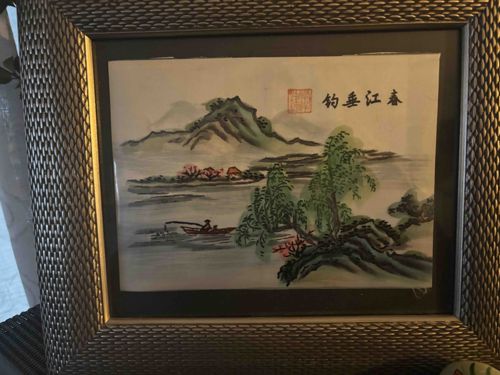
Chinese Shanshui Silk Painting of a Fisherman

Asian Art - Chinese Paintings

AI Estimated Value

·Not an official valuation·Verify before acting

$450 - $650

As of June 20, 2026

AI Item Analysis

·AI can make mistakes·Verify before acting
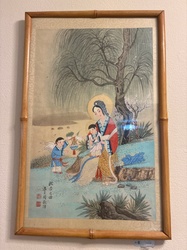
This is a hand-painted Chinese landscape (Shanshui) executed on a silk substrate, presented in a contemporary decorative frame. The composition features traditional motifs including a lone fisherman in a sampan boat on a serene river, framed by a prominent willow tree in the foreground and rolling mist-covered mountains in the distant background. The color palette utilizes soft greens, earthy browns, and muted blues, typically achieved through mineral pigments or ink washes. In the upper right quadrant, four calligraphic characters are visible next to a red cinnabar-paste square seal, which likely identifies the artist or provides a poetic title for the scene. The texture of the silk is visible beneath the paint, providing a luminous, slightly reflective quality characteristic of this medium. The painting appears to be in fair condition, though there is visible rippling or 'cockling' of the silk surface, likely due to fluctuations in humidity or improper mounting. There is a slight yellowing or patina to the silk consistent with mid-20th-century age, though the frame is a modern replacement with a metallic bronze-tone scales texture. The brushwork shows varying line widths, particularly in the jagged rock formations and the delicate weeping foliage of the tree, indicating a practiced hand.
AI Appraisal Report

·AI can make mistakes·Verify before acting
I have carefully examined the provided description and visual characteristics of this Shanshui silk painting. This work follows the Southern School tradition, utilizing 'p'i-ma ts'un' (hemp-fiber) brushstrokes to define the mountain contours. The utilization of silk as a substrate provides a distinctive luminosity; however, the visible 'cockling' or rippling of the fabric suggests significant tension issues and moisture exposure, which detracts from the aesthetic value. While the owner identifies this as an 'antique,' the stylistic execution and the modern metallic frame suggest a mid-20th-century creation aimed at the decorative export or regional collector market rather than a documented dynastic piece. The market for mid-century landscape scrolls and panels is currently stable but saturated, with value driven primarily by the quality of the calligraphy and the popularity of the 'lone fisherman' motif. Comparable sales for mid-20th-century silk paintings of this size and condition generally fall within the $400 to $800 range. The primary value-diminishing factor is the physical instability of the silk and the generic nature of the modern framing. Please note that a definitive attribution of the cinnabar seal cannot be made from images alone. A formal authentication would require an in-person microscopic inspection of the ink's absorption into the silk fibers to distinguish between hand-painted mineral pigments and sophisticated lithographic reproductions. Furthermore, a physical inspection of the silk's weave density and provenance documentation—such as acquisition records or historical exhibition labels—would be necessary to confirm an earlier date of origin, which could significantly increase the valuation.

Get your items appraised

Instant estimates of your treasures with AI-powered appraisals

Browse More Appraisals