AI estimate as of October 8, 2025 · verify with a professional before acting
AI-Generated · Verify before acting
Everything on this page is generated by AI for informational purposes only. AI can make mistakes — the AI may misidentify items or misattribute them (artist, maker, brand, designer, origin, era). This is not an official valuation and should not be used for insurance, sale, tax, estate, legal, or lending purposes — or any decision requiring a certified appraisal. It is not an authoritative claim about any person, brand, or rights holder — do not share or rely on it as a factual statement about a third party. Always consult qualified professionals before making financial decisions.
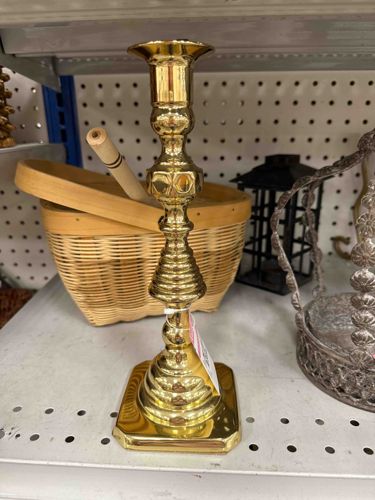
This item is a single, polished brass candlestick, exhibiting a traditional design. It is constructed from a solid, golden-hued metal, likely brass due to its characteristic shine and color. The candlestick stands upright, featuring a multi-faceted stem that showcases several distinct decorative elements. The base is square with chamfered corners, providing a stable foundation. Above the base, the stem begins with a series of stacked, concentric rings that taper upwards, creating a textured, almost pineapple-like appearance. This transitions into a smooth, rounded section, followed by a hexagonal or octagonal faceted section adorned with repeating circular or oval motifs on each face. A thinner, ornate section then leads to the flared bobeche at the top, designed to hold a standard taper candle. The top rim of the bobeche is slightly rolled or thickened, adding to its finished look. The surface displays a high polish, reflecting light brightly, though minor surface scratches or dust may be present consistent with an item on a retail shelf. There are no obvious dents, significant tarnishing, or active corrosion visible. A small white tag, possibly a price or inventory tag, is attached near the base of the stem, obscuring a small portion. The overall craftsmanship suggests a mass-produced item rather than a hand-forged piece, but with attention to decorative detail. Its style is reminiscent of traditional or colonial-inspired designs, potentially dating from the mid-to-late 20th century, though without specific maker's marks, a precise age is difficult to pinpoint. The shine indicates it has either been recently polished or is made from a brass alloy that resists significant tarnishing. This piece is designed for functional use as a candle holder or as a decorative accent.
AI Appraisal Report
Based on my visual examination of the provided image, this single brass candlestick presents in very good condition. The high polish suggests recent cleaning or a well-maintained surface, with no significant tarnishing, dents, or active corrosion visible. Minor surface scratches or dust are noted, consistent with typical retail handling. Authenticity, in terms of material, seems to be brass given its color and luster. However, without handling the item, I cannot confirm the exact alloy composition or its weight, which could influence perceived quality. The design, featuring a multifaceted stem with stacked rings and decorative facets, aligns with traditional or colonial aesthetics often seen in mass-produced home decor items from the mid-to-late 20th century. The small white tag near the base is likely an inventory or price tag, further supporting its retail origin.
Market conditions for such items are generally stable but not exceptionally strong. Comparable candlesticks of this style and apparent mass-produced quality typically retail in the $20-60 range depending on size, specific design intricacies, and vendor. Demand for single brass candlesticks is moderate, often purchased for decorative accents or to complete a pair. Rarity is low, as similar items were widely produced. Factors impacting value include its condition, solid construction (which appears to be the case), and aesthetic appeal. The lack of discernible maker's marks limits its value as a collectible antique, placing it firmly in the decorative home accent category.
Limitations in authenticity verification are significant. A physical examination would allow me to assess the weight, confirm the material through touch and potentially a brass test, inspect the craftsmanship for any hidden flaws or repairs, and check for maker's marks that are not visible in the image. Provenance documentation, if available, could establish a precise age or manufacturer. Without these, my appraisal is based purely on visual aesthetics and typical market trends for similar contemporary decorative brass items.