Grandma and grandpa wooden nicknacks and place holders
These notes were written by the person who submitted this item. Appraiser.AI has not verified them, and the AI's identification and estimate may rely on them.
AI Estimated Value
Not an official valuation
$5-15
AI estimate as of September 15, 2025 · verify with a professional before acting
AI-Generated · Verify before acting
Everything on this page is generated by AI for informational purposes only. AI can make mistakes — the AI may misidentify items or misattribute them (artist, maker, brand, designer, origin, era). This is not an official valuation and should not be used for insurance, sale, tax, estate, legal, or lending purposes — or any decision requiring a certified appraisal. It is not an authoritative claim about any person, brand, or rights holder — do not share or rely on it as a factual statement about a third party. Always consult qualified professionals before making financial decisions.
This analysis also relies on unverified notes provided by the user, which may be incomplete or inaccurate and could affect the result.
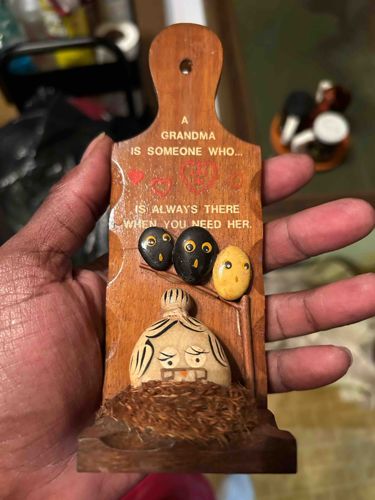
This item is a decorative wooden plaque, likely intended as a sentimental household accent or gift. It is crafted from a medium-toned wood, possibly a stained pine or similar economical timber, with a paddle-shaped top featuring a pre-drilled hole for hanging. The overall dimensions appear to be approximately 6-8 inches in height and 2-3 inches in width, though precise measurements are not possible from the image. The plank is carved with text in a light-colored, possibly painted or laser-etched font, reading: "A GRANDMA IS SOMEONE WHO... IS ALWAYS THERE WHEN YOU NEED HER." Above and below this text, there are faint red heart shapes, suggesting a loving sentiment. Below the text, there's a three-dimensional folk-art style scene. Three oval-shaped 'chicks' with painted eyes are perched on a carved wooden 'branch'. Two chicks are black with yellow eyes, and one is yellow with black eyes. Below them sits a larger, lighter-colored 'mother hen' figure, possibly representing the 'grandma', with carved features for eyes, beak, and stylized hair, nestled within a textured 'nest' made of what appears to be straw or finely shredded wood fibers. The bottom portion of the plaque forms a small, integrated base, allowing it to stand independently in addition to being hung. The craftsmanship suggests a commercially manufactured novelty item, rather than a fine art piece, likely from the mid to late 20th century. Condition appears to be good with some minor wear consistent with age and display, such as slight fading of the red hearts and a general patina on the wood. There are no obvious chips, cracks, or significant damage visible. The quality is indicative of mass-produced decorative items, focusing on sentimental appeal.
AI Appraisal Report
Upon examining the provided image and description of this decorative wooden plaque, I have determined its Fair Market Value. The item is a commercially manufactured, mass-produced decorative piece, likely dating from the latter half of the 20th century. My assessment of the condition, based on the visual information, is good. There is minor wear consistent with its age, such as slight fading on the painted hearts, but no significant damage like chips or cracks is apparent.
The primary value of this plaque is sentimental rather than monetary. The materials used—likely stained pine, simple paint, and natural fibers—are common and inexpensive. The folk-art style is charming but is characteristic of high-volume giftware and lacks the unique artisanship of a studio craft piece. Market comparables for similar mass-produced, sentimental wooden plaques from this era are plentiful on online marketplaces like eBay and Etsy, typically selling in the $5 to $15 range. Demand for such items is generally low and highly specific, driven by nostalgia rather than collectibility. The plaque's rarity is negligible, as it was designed for a broad consumer market.
No factors significantly increase its monetary value. It is important to note that this appraisal is based solely on images. A physical inspection would be necessary to confirm the specific type of wood, the method of text application (paint vs. etching), and to identify any potential maker's marks not visible in the photo. However, given the nature of the object, such findings are unlikely to substantially alter the valuation.