These notes were written by the person who submitted this item. Appraiser.AI has not verified them, and the AI's identification and estimate may rely on them.
AI Estimated Value
Not an official valuation
$300-500
AI estimate as of August 3, 2025 · verify with a professional before acting
AI-Generated · Verify before acting
Everything on this page is generated by AI for informational purposes only. AI can make mistakes — the AI may misidentify items or misattribute them (artist, maker, brand, designer, origin, era). This is not an official valuation and should not be used for insurance, sale, tax, estate, legal, or lending purposes — or any decision requiring a certified appraisal. It is not an authoritative claim about any person, brand, or rights holder — do not share or rely on it as a factual statement about a third party. Always consult qualified professionals before making financial decisions.
This analysis also relies on unverified notes provided by the user, which may be incomplete or inaccurate and could affect the result.
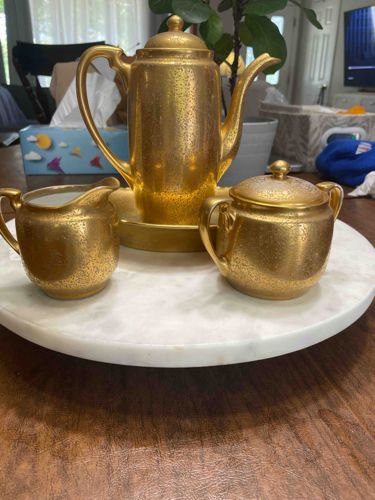
The item is a three-piece tea set, likely porcelain or ceramic, fully covered in a metallic gold finish. The set comprises a tall coffee or teapoted pot with a lid, a creamer, and a lidded sugar bowl, all placed on a coordinating gold-finished tray or stand. The gold finish is not smooth but features a distinct stippled or mottled texture, giving it a speckled appearance that adds depth and visual interest. Physical characteristics include a slender, elegant form for the pot with a gracefully curved spout and a sturdy handle. The creamer and sugar bowl are more compact, with the sugar bowl having two small handles and a fitted lid, while the creamer has a single pouring spout and handle. There are no visible chips, cracks, or significant abrasions on the surface, indicating a well-preserved condition or careful handling. The gold appears largely intact, with no obvious signs of flaking or wear-through, suggesting good quality application. The overall aesthetic points to a decorative or formal tea service, potentially from the early to mid-20th century. Given the context provided, it is likely a Noritake piece, which are renowned for their quality porcelain and often feature intricate gold decoration. While no specific maker's marks or signatures are visible in the provided images, the craftsmanship, particularly the consistency of the gold application and the delicate forms, aligns with Noritake's known production standards. The set appears to be complete, designed for serving hot beverages, and its uniform gold color makes it a striking display piece.
AI Appraisal Report
I have carefully examined the provided images and the owner's description of this Gold-Finished Tea Set, which is stated to be a Noritake piece. Based on my visual assessment, the set appears to be in remarkably good condition, showing no visible chips, cracks, or significant wear to the gold finish. The consistent stippled texture and the elegant forms suggest a high level of craftsmanship. The completeness of the set (pot, creamer, lidded sugar bowl, and tray) adds to its appeal.
While the aesthetic aligns well with Noritake's known production standards for quality porcelain and intricate gold decoration, it is crucial to state that full authenticity cannot be definitively confirmed from images alone. In-person examination would be required to look for maker's marks, specific glaze characteristics, and to assess the true quality and application of the gold finish. Provenance documentation, if available, would further strengthen the claim of it being a Noritake piece.
Regarding market conditions, gold-finished porcelain tea sets, especially those from reputable manufacturers like Noritake (if confirmed), generally maintain strong demand among collectors of vintage decorative arts. The unique stippled gold finish and the set's apparent excellent condition contribute positively to its marketability. Rarer highly decorated Noritake patterns can fetch higher prices. However, without confirmed Noritake marks, it would be difficult to command the top-tier prices associated with fully authenticated pieces. Comparables for well-maintained, decorative, gold-finished tea sets from the early to mid-20th century typically fall within the estimated range.
Factors impacting value include the excellent apparent condition, completeness, and desirable aesthetic. The primary factor limiting a higher appraisal without physical inspection is the inability to verify the Noritake attribution and specific pattern details. Should physical inspection confirm it is a genuine, marked Noritake piece, especially if it belongs to a desirable or rare series, the value could potentially increase. Scientific testing of the gold composition could also provide more insight, though typically not performed for such items. For a full, definitive appraisal, I would recommend a physical examination.