AI estimate as of October 22, 2025 · verify with a professional before acting
AI-Generated · Verify before acting
Everything on this page is generated by AI for informational purposes only. AI can make mistakes — the AI may misidentify items or misattribute them (artist, maker, brand, designer, origin, era). This is not an official valuation and should not be used for insurance, sale, tax, estate, legal, or lending purposes — or any decision requiring a certified appraisal. It is not an authoritative claim about any person, brand, or rights holder — do not share or rely on it as a factual statement about a third party. Always consult qualified professionals before making financial decisions.
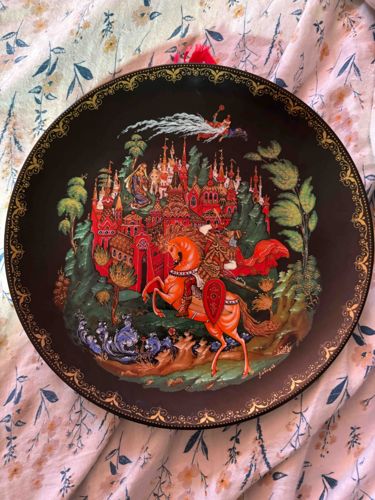
This is a round, flat decorative plate crafted from what appears to be lacquered papier-mâché or wood, characteristic of traditional Russian lacquer miniature painting. The predominant color of the plate itself is a deep, glossy black, which serves as a striking backdrop for the intricate, hand-painted scene. The central motif depicts a vibrant, fantastical scene from what is likely Russian folklore or fairy tales. A prominent figure, possibly a hero or knight, is shown mounted on a rearing orange horse, equipped with a shield and what appears to be a headdress. Behind this central figure, a sprawling, ornate city or palace with numerous red-roofed buildings and spires is visible, nestled amidst lush green trees and foliage. In the upper left quadrant of the painting, another ethereal figure is depicted, possibly a princess or a mythical being, with flowing garments and a white, cloud-like element suggesting movement or magic. The artist uses a rich palette of colors, including various shades of red, green, gold, blue, and white, with fine details and delicate brushwork evident throughout the composition. A decorative border in gold and black, featuring stylized scrollwork or floral patterns, encircles the entire painted scene, adding to its ornamental quality. While the exact size is not discernible from the image, it appears to be a medium-sized plate, typical for display. The finish is highly glossy, reflecting light, which suggests a well-preserved lacquer coating. There are no immediately visible signs of damage, cracks, or significant wear, though a closer inspection would be needed to confirm the absence of minor imperfections or crazing in the lacquer. The style suggests a 20th-century Russian Palekh, Fedoskino, Mstera, or Kholuy lacquer piece, known for their elaborate storytelling and vibrant imagery.
AI Appraisal Report
Based on my visual examination of this Russian lacquer art decorative plate, the piece presents as a high-quality example of traditional Russian miniature painting, likely from one of the renowned schools such as Palekh, Fedoskino, Mstera, or Kholuy. The deep black lacquer base provides an excellent contrast for the vibrant, intricately painted scene, which appears to depict a dramatic folklore or fairy tale narrative. The colors are rich and well-preserved, and the delicate brushwork is indicative of a skilled artisan. The glossy finish suggests a well-maintained lacquer coating, and I observe no immediate signs of chips, cracks, or significant wear from the image provided. This visually excellent condition significantly contributes to its value.
Market conditions for authentic Russian lacquer art, particularly pieces with compelling narrative scenes and fine detail, remain strong among collectors of cultural and decorative arts. Comparables within this category, especially those illustrating intricate storytelling, tend to fetch good prices at auction and through specialist dealers. The demand for such pieces is consistent, largely due to their artistic merit, historical significance, and the painstaking craftsmanship involved. While not exceedingly rare, a piece with such a detailed and well-executed scene, combined with good condition, is always sought after.
However, it is crucial to state that this appraisal is based solely on visual assessment from an image. A definitive authentication and more precise valuation would require an in-person examination to verify the material (papier-mâché or wood), intricately inspect the paint layers for authenticity of technique, and search for the artist's signature or school hallmark, which is often tiny and might be hidden. Provenance documentation could also significantly impact its value by confirming origin and any notable historical ownership. Without these, the attribution to a specific school or artist, which can vastly alter market value, remains an estimation. My valuation reflects its perceived quality and condition from the image, assuming authenticity typical of such pieces.