AI Appraisal Estimate

AI-generated estimates · not official valuations

From the user

What was submitted

Photo and notes provided by the user — not generated by AI

Submitted item photo
Submitted photo · June 3, 2026

User's notes

No additional notes provided.

AI analysis below

AI appraisal

AI analysis & estimate

AI-Generated · Verify before acting

Everything below is generated by AI for informational purposes only. AI can make mistakes — the AI may misidentify items or misattribute them (artist, maker, brand, designer, origin, era). This is not an official valuation and should not be used for insurance, sale, tax, estate, legal, or lending purposes — or any decision requiring a certified appraisal. It is not an authoritative claim about any person, brand, or rights holder — do not share or rely on it as a factual statement about a third party. Always consult qualified professionals before making financial decisions.

Read the full disclaimer

AI Identification

·Not independently authenticated·Verify before acting

Vintage Japanese Lusterware Poppy Teapot

Antique/Vintage Ceramics & Teaware

AI Estimated Value

·Not an official valuation·Verify before acting

$45 - $65

As of June 3, 2026

AI Item Analysis

·AI can make mistakes·Verify before acting
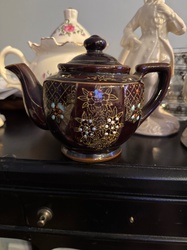
This is a vintage Japanese porcelain teapot featuring a classic lusterware finish. The vessel displays a bulbous body with a tapered base and a stepped shoulder leading to a matching lid with a round finial. The primary decorative motif consists of large, hand-painted orange and red poppies with black centers and green foliage, encircling the center of the pot against a white background. This central band is framed by a light blue iridescent luster glaze on the upper portion and lid, while the lower base and spout transition into a peachy-orange luster tone. The handle is finished in a coordinating blue metallic sheen. The lusterware technique gives the ceramic a pearlescent, metallic quality common in mid-20th-century Japanese imports (roughly 1930s-1950s). The construction shows fine proportions with a high-arching geometric handle and a curved spout. While maker's marks are not visible from this angle, they are typically found on the underside (often 'Hand Painted Made in Japan'). The condition appears generally good with original color depth, though some minor rubbing to the luster glaze and light surface wear consistent with age and occasional use may be present upon closer tactile inspection. The craftsmanship is typical of high-quality Japanese export porcelain of the Art Deco influenced period.
AI Appraisal Report

·AI can make mistakes·Verify before acting
Based on my visual examination of this vintage Japanese lusterware teapot, I have identified it as a classic example of export porcelain from the 1930s or early 1940s, likely produced during the late Art Deco period. The piece exhibits the characteristic pearlescent metallic finish known as lusterware, achieved through a thin metallic film over the glaze. This specific design, featuring hand-painted floral poppies against a split field of blue and peachy-orange luster, was highly popular for North American export. The condition appears structurally sound with vibrant pigment; however, lusterware is notoriously delicate, and I observe minor rubbing on the handle and spout contact points, which is typical for its age. The market for mid-range Japanese export porcelain remains stable but saturated, as these items were mass-produced for the global market. While aesthetically pleasing, they do not currently command the high prices of earlier Meiji-era ceramics or specific signed Nippon pieces. This valuation reflects recent auction results for similar 'Made in Japan' marked teapots in excellent condition. Limitations: This appraisal is based solely on digital images. A physical inspection is required to confirm the absence of hairline fractures, professional restorations, or 'flea bites' on the inner rim. Verification of the backstamp is necessary to definitively date the piece (e.g., 'Occupied Japan' would shift the date to 1947–1952). Full authentication would involve tactile assessment of the porcelain's translucency and weight to ensure it is not a modern reproduction.

Get your items appraised

Instant estimates of your treasures with AI-powered appraisals

Browse More Appraisals