AI estimate as of July 12, 2025 · verify with a professional before acting
AI-Generated · Verify before acting
Everything on this page is generated by AI for informational purposes only. AI can make mistakes — the AI may misidentify items or misattribute them (artist, maker, brand, designer, origin, era). This is not an official valuation and should not be used for insurance, sale, tax, estate, legal, or lending purposes — or any decision requiring a certified appraisal. It is not an authoritative claim about any person, brand, or rights holder — do not share or rely on it as a factual statement about a third party. Always consult qualified professionals before making financial decisions.
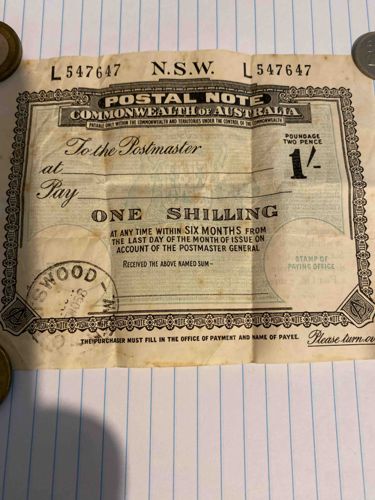
This item is an Australian Commonwealth Postal Note for "One Shilling" with a stated 'Poundage Two Pence'. It is a rectangular document made of thin, pale cream-colored paper, measuring approximately 7 inches by 4 inches. The design features a decorative border with intricate patterns, suggesting an official and secure document. The text is printed in black ink, with some areas featuring a darker, more prominent font, such as 'POSTAL NOTE' and 'COMMONWEALTH OF AUSTRALIA'. The serial number 'L547647' is printed twice at the top, along with 'N.S.W.' (presumably indicating New South Wales). There are blank lines for 'To the Postmaster', 'at', and 'Pay', indicating fields to be manually filled. A prominent instruction states, 'AT ANY TIME WITHIN SIX MONTHS FROM THE LAST DAY OF THE MONTH OF ISSUE ON ACCOUNT OF THE POSTMASTER GENERAL'. Another line reads 'RECEIVED THE ABOVE NAMED SUM-'. Two circular stamps are visible, one partially obscured but reading 'SWOOD' and what appears to be a date '1958', indicating a post office or issuing location and date. The right circular area is labeled 'STAMP OF PAYING OFFICE'. At the bottom, a fine print instruction states, 'THE PURCHASER MUST FILL IN THE OFFICE OF PAYMENT AND NAME OF PAYEE'. The phrase 'Please turn over' suggests there is additional information on the reverse side. The paper shows significant signs of age and use, including multiple strong creases and folds across its surface, notably a prominent vertical fold down the center and several horizontal folds. There is visible discoloration and dirt accumulation, particularly along the fold lines and edges, contributing to a worn patina. The paper is slightly yellowed with age, and the edges appear somewhat softened. Despite the wear, the printing remains legible. This specific postal note, given the '1958' stamp, dates to the mid-20th century.
AI Appraisal Report
I have examined the image of this Australian Commonwealth Postal Note (One Shilling). This note, dated 1958 based on the visible stamp, is a fascinating piece of philatelic and financial history. The condition, while showing significant age and use with multiple strong creases, folds, discoloration, and dirt accumulation, is still legible. These factors, particularly the prominent folds and soiling, detract from its aesthetic appeal and overall grade. Authenticity appears good based on the printing style, denominations, and serial number format which aligns with known examples of these postal notes from the mid-20th century. However, definitive authenticity verification would require in-person examination to assess paper quality, watermarks (if any), and printing methods more closely. Provenance documentation, such as the note's history of ownership or issuance, would also strengthen authentication. Scientific testing like ink analysis or paper fiber analysis would be beneficial but is typically reserved for higher-value items.
In terms of market conditions, Australian postal notes are collected, but their values are highly dependent on condition and rarity. Common denominations in circulated condition, like this one, typically fetch modest prices. The 'One Shilling' denomination is not particularly rare. Given its condition, which would be rated as 'Fair to Good' due to the heavy creasing and soiling, the demand is primarily from entry-level collectors or those looking for an example of this specific type. Higher-grade examples command better prices, but this note falls into the heavily circulated category. Comparables for similar notes in this condition typically range from a few dollars up to about ten dollars. Factors significantly impacting value here are primarily the condition issues. The presence of the '1958' stamp does confirm its usage, adding a historical dimension, but doesn't elevate its value significantly for this common denomination.