AI Appraisal Estimate

AI-generated estimates · not official valuations

From the user

What was submitted

Photo and notes provided by the user — not generated by AI

Submitted item photo
Submitted photo · June 23, 2026

User's notes

No additional notes provided.

AI analysis below

AI appraisal

AI analysis & estimate

AI-Generated · Verify before acting

Everything below is generated by AI for informational purposes only. AI can make mistakes — the AI may misidentify items or misattribute them (artist, maker, brand, designer, origin, era). This is not an official valuation and should not be used for insurance, sale, tax, estate, legal, or lending purposes — or any decision requiring a certified appraisal. It is not an authoritative claim about any person, brand, or rights holder — do not share or rely on it as a factual statement about a third party. Always consult qualified professionals before making financial decisions.

Read the full disclaimer

AI Identification

·Not independently authenticated·Verify before acting

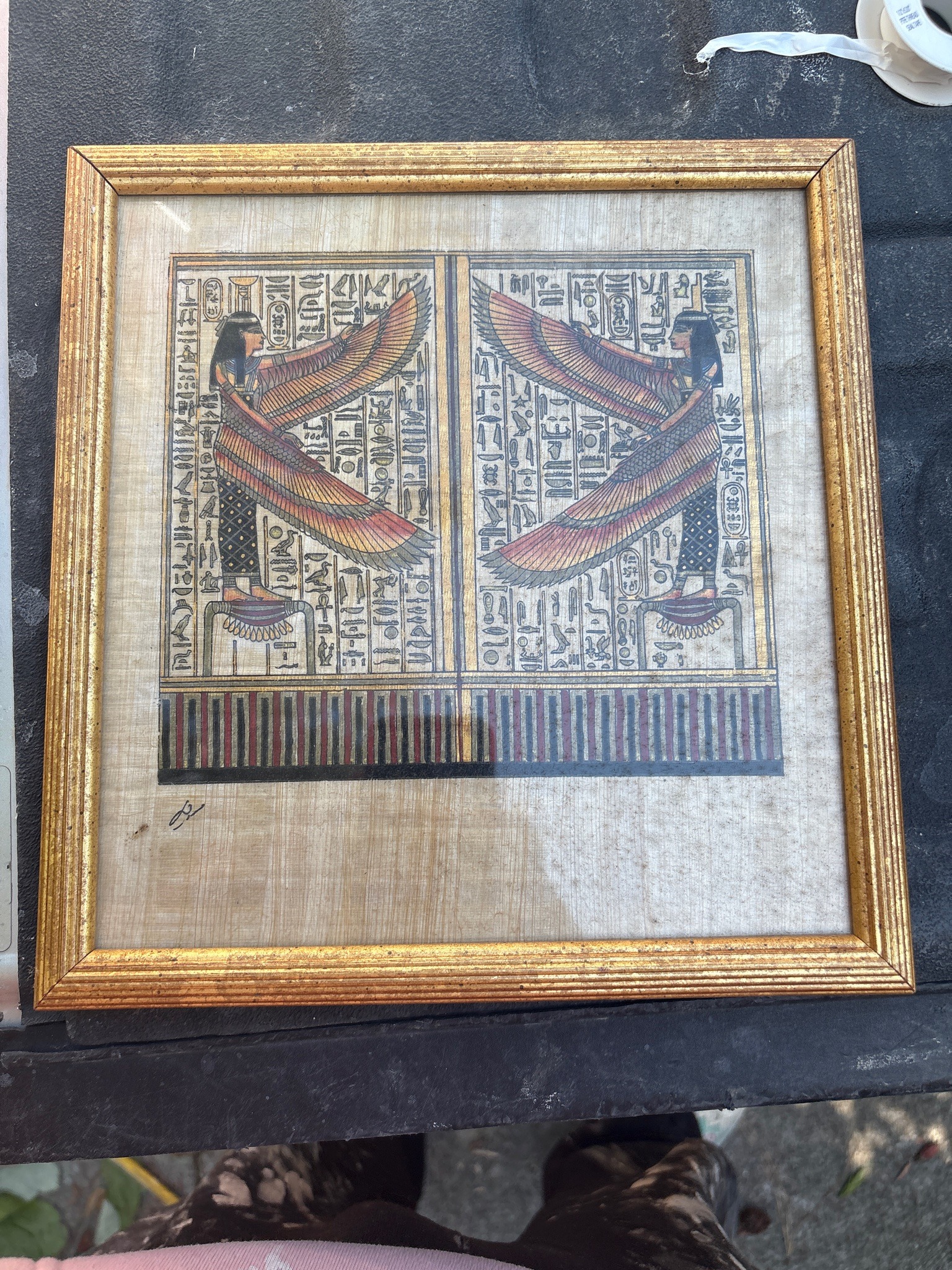
Modern Egyptian Papyrus Painting of Winged Goddesses Isis and Nephthys

Decorative Arts / Souvenir Art

AI Estimated Value

·Not an official valuation·Verify before acting

$60 - $100

As of June 23, 2026

AI Item Analysis

·AI can make mistakes·Verify before acting
This is a framed souvenir-style painting executed on genuine papyrus, featuring two symmetrical figures of winged Egyptian deities, likely representing the sister goddesses Isis and Nephthys. The artwork is characterized by the traditional woven texture of papyrus fibers, showing the horizontal and vertical overlapping strips typical of the material. The central composition depicts the goddesses standing on 'neb' baskets, with outstretched wings decorated in horizontal bands of red, gold, and black. Their skirts feature a detailed geometric pattern, while the background is filled with decorative hieroglyphs presented in vertical columns. Below the figures is a stylized dado or frieze of vertical red, black, and gold stripes. The color palette consists of earthy tones, primarily gold, terracotta red, black, and blue-gray. In the lower-left area of the papyrus sheet, there is a small black signature or mark in Arabic script, commonly found on 20th-century artisanal souvenir pieces from Egypt. The item is housed in a contemporary fluted wooden frame with a gold metallic finish. The condition appears fair to good, with some visible rippling of the papyrus sheet behind the glass, slight fraying at the edges of the organic material, and light surface wear to the frame's gilt finish. This is a modern decorative piece (circa late 20th century) mass-produced for the tourism trade, meant to emulate ancient tomb paintings such as those found in the Valley of the Queens.
AI Appraisal Report

·AI can make mistakes·Verify before acting
I have completed a visual examination of this framed Egyptian papyrus painting depicting the goddesses Isis and Nephthys. My analysis identifies this as a decorative souvenir piece, likely produced in the late 20th century. While the substrate is genuine cyperus papyrus, the application of pigments and the presence of an Arabic signature in the lower-left quadrant are characteristic of artisanal mass-production for the Egyptian tourist market rather than a unique fine art commission. The condition is fair to good; the rippling and edge fraying observed are typical for organic papyrus fibers under glass, though the frame shows minor gilt loss. The current market for such souvenir items is saturated, with high availability through online marketplaces and estate sales. Rarity is non-existent as these motifs are standardized. Factors limiting value include its contemporary manufacture and the decorative nature of the painting techniques used. My valuation is based on similar sold comparables of framed tourist-grade papyri found in decorative arts auctions and secondary markets. Limitations: This appraisal is based solely on digital images. A physical inspection is required to determine the exact nature of the pigments (hand-painted vs. silkscreened) and to verify if the frame utilizes archival mounting to prevent further degradation of the organic material. No provenance was provided; documentation from a known Egyptian atelier would confirm its origin but likely not shift its classification from decorative to fine art.

Get your items appraised

Instant estimates of your treasures with AI-powered appraisals

Browse More Appraisals