These notes were written by the person who submitted this item. Appraiser.AI has not verified them, and the AI's identification and estimate may rely on them.
AI Estimated Value
Not an official valuation
$10-30
AI estimate as of June 20, 2025 · verify with a professional before acting
AI-Generated · Verify before acting
Everything on this page is generated by AI for informational purposes only. AI can make mistakes — the AI may misidentify items or misattribute them (artist, maker, brand, designer, origin, era). This is not an official valuation and should not be used for insurance, sale, tax, estate, legal, or lending purposes — or any decision requiring a certified appraisal. It is not an authoritative claim about any person, brand, or rights holder — do not share or rely on it as a factual statement about a third party. Always consult qualified professionals before making financial decisions.
This analysis also relies on unverified notes provided by the user, which may be incomplete or inaccurate and could affect the result.
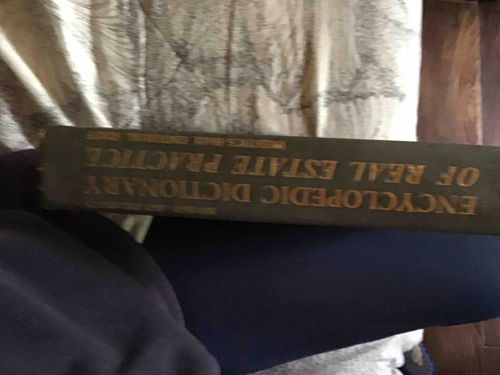
The item is a hardbound book titled "ENCYCLOPEDIC DICTIONARY OF REAL ESTATE PRACTICE", with additional text below that appears to be publisher or edition information, possibly "PARKERS BARN CONTEMPORARY SERIES" or similar, though partially obscured. The book features a dark, possibly olive green or deep brown cover, with the title embossed or printed in a metallic, gold-colored font on the spine. The visible surface of the spine shows a generally good condition, consistent with the provided context, with no apparent tears, significant scuffs, or major damage, suggesting it has been well-maintained. The edges of the spine appear relatively crisp, indicating minimal shelf wear or handling. The book's construction appears sturdy and typical of academic or reference texts, designed for frequent use. Given the topic, it likely contains a substantial number of pages and is of a standard size for a professional reference book, likely around 9-11 inches in height. Based on the subject matter and visible typeface, the estimated age is likely mid-to-late 20th century, possibly 1970s or 1980s, a period when such comprehensive real estate resources were highly valued. Quality indicators include the clear, legible printing and what appears to be a durable binding, although further assessment of the interior pages and binding structure would be required for a complete quality evaluation. There are no readily visible unique markings or manufacturer details on the spine beyond the title information.
AI Appraisal Report
I have examined the image of this hardbound book, 'ENCYCLOPEDIC DICTIONARY OF REAL ESTATE PRACTICE.' Visually, its condition appears good, consistent with the owner's description. The spine shows no significant damage, scuffs, or tears, suggesting careful handling. The gold-colored title remains clear and legible. This book likely dates from the mid-to-late 20th century, possibly the 1970s or 1980s, given the subject matter and general appearance, as reference texts like this were staples in the real estate profession during that era. While the binding appears sturdy from the image, a full assessment of quality would require inspecting the internal pages for foxing, inscriptions, or binding integrity. For this type of academic or professional reference book, market demand is niche. Newer editions or online resources have largely superseded older encyclopedic texts, reducing demand for physical copies. Rarity is not a significant factor; these were mass-produced. Consequently, the value of such a volume, even in good condition, is primarily for its historical reference or if a collector specifically seeks an early edition. Factors impacting value negatively include obsolescence of information and general availability. Without physical inspection, I cannot verify print quality throughout, confirm the absence of internal damage, or ascertain the exact edition or publisher details beyond the visible title. A physical examination would allow me to check the copyright page for publication date and publisher, assess the paper quality, and confirm the absence of mold or significant wear. Without this, full authentication is limited to visual assessment of the exterior.