AI Appraisal Estimate

AI-generated estimates · not official valuations

From the user

What was submitted

Photo and notes provided by the user — not generated by AI

Submitted item photo
Submitted photo · June 8, 2026

User's notes

No additional notes provided.

AI analysis below

AI appraisal

AI analysis & estimate

AI-Generated · Verify before acting

Everything below is generated by AI for informational purposes only. AI can make mistakes — the AI may misidentify items or misattribute them (artist, maker, brand, designer, origin, era). This is not an official valuation and should not be used for insurance, sale, tax, estate, legal, or lending purposes — or any decision requiring a certified appraisal. It is not an authoritative claim about any person, brand, or rights holder — do not share or rely on it as a factual statement about a third party. Always consult qualified professionals before making financial decisions.

Read the full disclaimer

AI Identification

·Not independently authenticated·Verify before acting

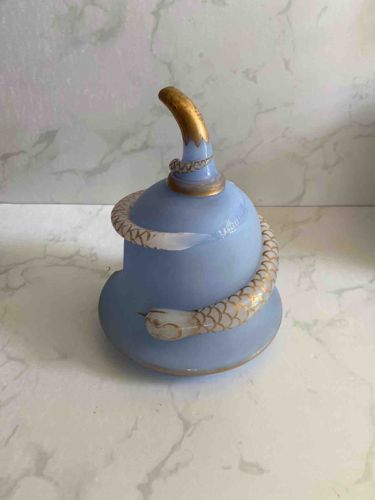
Periwinkle Blue Decorative Cloche with Gilded Serpent Motif

Decorative Arts

AI Estimated Value

·Not an official valuation·Verify before acting

$75 - $150

As of June 8, 2026

AI Item Analysis

·AI can make mistakes·Verify before acting
This item is a decorative bell cloche or possibly a stopper, made of what appears to be ceramic or glass, with a matte, pale periwinkle blue finish. Its form is conical, flaring out slightly at the base, and topped with a curved, pointed finial that is entirely gilded in a rich gold. A prominent decorative feature is a sculpted serpent, possibly made of bisque porcelain or ceramic, that wraps around the body of the object, starting near the finial and descending towards the base. The serpent is predominantly off-white or cream-colored, adorned with a consistent scale pattern highlighted in gold. The tail end of the serpent, visible towards the bottom right, tapers to a point. There is significant visible damage, particularly a large chip or loss of material on the upper left side, revealing the underlying body material as white. Small traces of gold trim are also visible around the base of the object, complementing the gold on the finial and serpent details. The craftsmanship of the serpent's scales suggests attention to detail. This piece likely dates from a period when such whimsical or classical motifs were popular in decorative items, perhaps late 19th to early 20th century. Its artistic style leans towards Art Nouveau or Victorian aesthetics due to the elaborate nature of the serpent and the use of gilding.
AI Appraisal Report

·AI can make mistakes·Verify before acting
Upon examining the image of this Periwinkle Blue Decorative Cloche with Gilded Serpent Motif, I find it to be a piece of intriguing decorative arts. The matte periwinkle blue finish, conical form, and gilded finial suggest a design popular in the late 19th to early 20th century, aligning with Art Nouveau or Victorian aesthetics. The sculpted serpent, with its detailed scales highlighted in gold, is a particularly striking feature, indicating skilled craftsmanship. However, the most significant factor impacting its value is the visible damage—a large chip on the upper left, revealing a white core which suggests either ceramic or a heavily coated glass. This damage substantially diminishes its aesthetic appeal and structural integrity. Had it been in excellent condition, comparable pieces with similar intricate animal motifs and gilding, especially from established historical periods, could fetch significantly higher prices due to their decorative appeal and potential rarity. Market demand for such whimsical historical decorative items remains consistent, especially if tied to specific design movements. However, the condition issue significantly narrows its appeal to collectors often seeking pristine examples. While the craftsmanship of the serpent is notable, the overall condition reduces it from a collector's item to a decorative curiosity. For a full authentication, I would need a physical examination to confirm the material (ceramic vs. glass), assess the quality of the gilding, and investigate the method of serpent attachment. True age and origin could be verified through provenance documentation if available, or scientific testing of materials. Without physical inspection, I cannot definitively confirm authenticity beyond visual cues, nor can I rule out reproductions made to appear aged.

Get your items appraised

Instant estimates of your treasures with AI-powered appraisals

Browse More Appraisals