AI estimate as of August 26, 2025 · verify with a professional before acting
AI-Generated · Verify before acting
Everything on this page is generated by AI for informational purposes only. AI can make mistakes — the AI may misidentify items or misattribute them (artist, maker, brand, designer, origin, era). This is not an official valuation and should not be used for insurance, sale, tax, estate, legal, or lending purposes — or any decision requiring a certified appraisal. It is not an authoritative claim about any person, brand, or rights holder — do not share or rely on it as a factual statement about a third party. Always consult qualified professionals before making financial decisions.
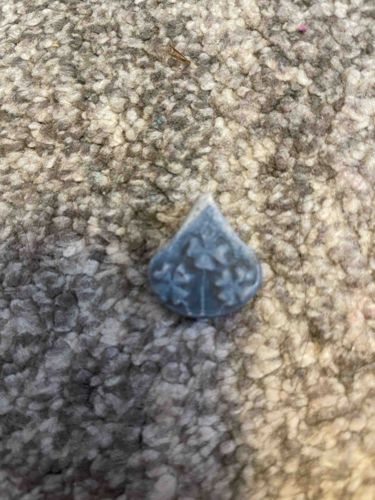
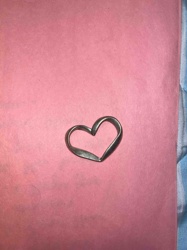
The item appears to be a small, teardrop-shaped decorative element, likely made from a resin, ceramic, or molded plastic material. Its color is a faded, muted blue or grayish-blue, suggesting either an intentional antique finish or some degree of fading/patina over time. The surface features a molded or impressed relief pattern, consisting of what appear to be stylized floral or snowflake-like motifs scattered across its face. There are approximately five such patterns discernible, with a central line or groove running vertically through the object, possibly indicating a mold seam or a design element. This central line appears to separate two distinct, slightly raised portions of the item. The craftsmanship seems to be of a mass-produced nature, given the uniformity of the molded patterns. There are no visible maker's marks or signatures. Its small size, resting on a textured carpet, implies it is a component for jewelry, crafting, or a small decorative accent. The visible condition is good, with no obvious chips, cracks, or significant wear beyond the possible intentional distressing of its coloring. Based on its design and material type, it could date from the late 20th century to contemporary, possibly aiming for a vintage or shabby-chic aesthetic. The backside is not visible to assess its full construction or additional features.
AI Appraisal Report
Upon visual examination of the provided image, this teardrop-shaped embellishment appears to be a mass-produced decorative component, likely intended for crafting or small decorative applications. Its faded, muted blue/gray hue and stylized floral/snowflake motifs suggest a design aesthetic common in the late 20th century to contemporary crafting, particularly aiming for a vintage or 'shabby-chic' appeal. The material appears to be resin, ceramic, or molded plastic, consistent with low-cost manufacturing. The uniform molded patterns and absence of maker's marks reinforce its probable mass-produced nature.
My assessment of its condition, based solely on the image, is excellent; no chips, cracks, or significant wear are visible, beyond what might be an intentional distressed finish. Authenticity, in the sense of being a genuine antique or a unique artisan piece, cannot be confirmed from the image. It is almost certainly a modern, manufactured item.
Market conditions for such items are characterized by high volume and low individual prices. Comparables are readily available in craft stores, online marketplaces, and textile/jewelry supply wholesalers. Demand is steady among hobbyists and crafters, but individual rarity is non-existent due to mass production. Factors significantly impacting its value include material (inexpensive), lack of artist attribution, and commonality of design.
Limitations in authenticity verification from images alone are substantial for this item. A physical examination would allow for definitive material identification (e.g., distinguishing resin from ceramic by tactile feel and weight), assessment of the back surface, and precise measurement. Provenance documentation (e.g., original purchase receipts, manufacturing details) would confirm its origin and age. However, for an item of this type, such in-depth authentication is typically not warranted given its low intrinsic value. No scientific testing would be necessary.