AI estimate as of August 26, 2025 · verify with a professional before acting
AI-Generated · Verify before acting
Everything on this page is generated by AI for informational purposes only. AI can make mistakes — the AI may misidentify items or misattribute them (artist, maker, brand, designer, origin, era). This is not an official valuation and should not be used for insurance, sale, tax, estate, legal, or lending purposes — or any decision requiring a certified appraisal. It is not an authoritative claim about any person, brand, or rights holder — do not share or rely on it as a factual statement about a third party. Always consult qualified professionals before making financial decisions.
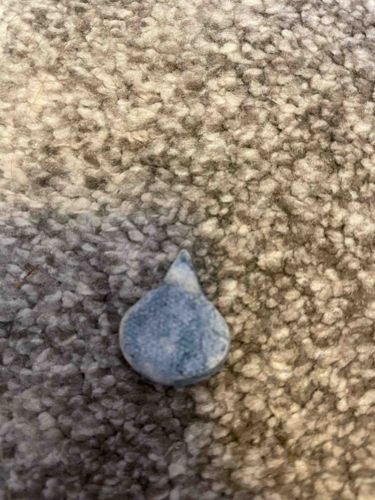
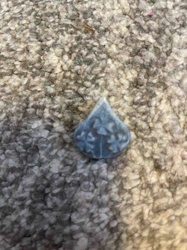
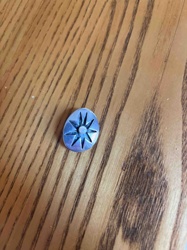
This item appears to be a small, teardrop-shaped decorative object or bead, likely made from ceramic, glass, or a polished stone material. Its primary color is a muted, light blue, with a distinct lighter, almost white, streak or gradient extending from the pointed tip downwards, possibly indicating a natural variation in material or a deliberate design choice. The surface exhibits a somewhat matte or frosted finish, rather than highly polished, suggesting either a specific material (like sea glass or certain unglazed ceramics) or a finish applied to soften its appearance. The edges appear smooth and rounded, with no sharp facets, implying a tumbled or molded construction. Its diminutive size is evident when compared to the surrounding carpet fibers, placing it likely within the range of 1 to 2 centimeters in length. There are no visible chips, cracks, or significant abrasions, suggesting it is in good, used condition. No specific maker's marks or signatures are discernible from the provided image. Given its appearance, it could be a component for jewelry making, a small decorative accent, or a collectible pebble. The craftsmanship appears simple but effective, creating a pleasing and organic form. Its lack of any obvious mounting points suggests it might be a cabochon, a loose bead, or simply a decorative piece meant to be displayed as is.
AI Appraisal Report
I have examined the provided image of the teardrop-shaped blue object. Based on the visual evidence, I assess its condition as good, showing no obvious chips, cracks, or significant wear. Its authenticity as a decorative object or craft supply appears self-evident; there are no complex features that would suggest counterfeiting.
Market conditions for such small, unmounted decorative items are generally low. Comparables would include mass-produced glass cabochons, tumbled stones, or ceramic beads. Items of this nature are widely available through craft supply stores, online marketplaces, and hobby shops. Its lack of discernible maker's marks, precious materials, or historical significance places it firmly in the category of common craft components.
Demand for individual pieces like this is limited, primarily driven by crafters or collectors seeking specific colors or shapes for projects. Rarity is not a factor here; similar items are produced in vast quantities. The primary factors impacting its value are its material (likely glass, ceramic, or polymer), its common form, and its lack of any unique identifying features or provenance.
Limitations in authenticity verification from images alone are significant. While its general nature is clear, precise material identification (e.g., distinguishing between sea glass, dyed stone, or polymer) cannot be confirmed without physical inspection. An in-person examination would allow for tactile assessment, specific gravity testing, and precise measurement. Provenance documentation would be necessary if it were presented as a piece from a significant collection or artist. However, for an item of this type, such extensive verification is generally not warranted given its low intrinsic value.