AI estimate as of December 6, 2025 · verify with a professional before acting
AI-Generated · Verify before acting
Everything on this page is generated by AI for informational purposes only. AI can make mistakes — the AI may misidentify items or misattribute them (artist, maker, brand, designer, origin, era). This is not an official valuation and should not be used for insurance, sale, tax, estate, legal, or lending purposes — or any decision requiring a certified appraisal. It is not an authoritative claim about any person, brand, or rights holder — do not share or rely on it as a factual statement about a third party. Always consult qualified professionals before making financial decisions.
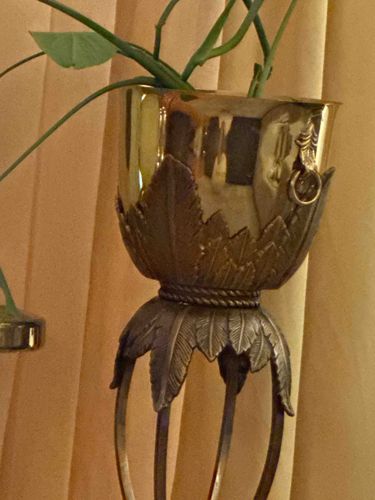
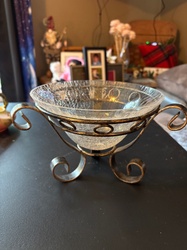
This item is a decorative planter assembly, featuring a polished brass planter cup resting on an ornate, patinated metal stand. The planter cup itself is cylindrical with an outwardly flared rim, exhibiting a bright, reflective golden brass finish. It appears to be made from sheet brass, likely spun or formed. The upper portion of the cup has a smooth, unadorned surface. Below this, approximately a third of the way down from the rim, there is a band of applied or repousséd detailing, most prominently visible on the right side. This detail appears to be a classical-style mask or head, possibly a lion or gargoyle, from which a decorative ring handle is suspended. The lower half of the brass cup is covered with a repeating pattern of embossed or cast leaf motifs, creating a textured, almost organic appearance. The brass shows some minor surface wear consistent with age and handling, and reflections indicate a polished but possibly not perfectly new surface. The planter sits atop a separate stand made of a darker, possibly bronzed or antiqued brass or other base metal. This stand features a prominent rope-twist band directly below where it supports the planter. Below this, there is another layer of intricate, overlapping leaf-like ornamentation, from which four slender, gracefully curving legs descend. These legs appear to broaden slightly at their base, hinting at stability. The stand exhibits a darker, more aged patina compared to the bright planter, suggesting it may be a different material or has undergone a different finishing process. The overall aesthetic is classical or possibly Art Nouveau inspired, given the organic leaf patterns and the decorative mask. There are no visible manufacturing marks or signatures in the provided image. The craftsmanship appears to be of good quality, with attention to detail in the cast or embossed elements.
AI Appraisal Report
Based on my visual examination of the provided image, this Brass Planter on Ornate Stand presents as a charming decorative piece. The brass planter cup appears to be in good overall condition, exhibiting a bright finish with some minor surface wear commensurate with age, suggesting it has been cared for but is not pristine. The embossed leaf motifs and the classical-style mask with a ring handle show good detail, indicating quality craftsmanship. The stand, with its darker patina and intricate leaf ornamentation and rope-twist band, complements the planter well. The combination of styles, with classical elements and organic motifs, suggests a late 19th to early 20th-century aesthetic, possibly influenced by Art Nouveau.
In terms of market conditions, decorative planters of this nature generally appeal to collectors of antique home decor and those looking for accent pieces with a vintage charm. While attractive, items like this brass planter, without specific provenance or identifiable maker's marks, fall into a broad category of decorative antiques. Comparables found in online antique marketplaces and auction results for similar unsigned brass and metal planters on stands typically range from $150 to $500, with condition and intricacy heavily influencing the higher end of that spectrum. Demand for such items is steady but not exceptionally high, and rarity is difficult to assess without more information on the maker or origin.
The primary factors impacting value are its decorative appeal, good condition, and apparent age. However, the lack of any visible manufacturing marks is a limiting factor in determining a higher value, as is often the case with decorative household items. Without direct physical examination, I cannot definitively assess the exact material composition of the stand (e.g., solid bronze vs. brass-plated base metal), the method of construction, or the true extent of any wear, dents, or repairs. An in-person inspection would allow for a thorough examination of seams, weight, and patination, which could provide clues to its origin and true age. Furthermore, documentation of provenance would be crucial for verifying authenticity and potentially connecting it to a known manufacturer or designer, which could significantly increase its value.