AI estimate as of October 7, 2025 · verify with a professional before acting
AI-Generated · Verify before acting
Everything on this page is generated by AI for informational purposes only. AI can make mistakes — the AI may misidentify items or misattribute them (artist, maker, brand, designer, origin, era). This is not an official valuation and should not be used for insurance, sale, tax, estate, legal, or lending purposes — or any decision requiring a certified appraisal. It is not an authoritative claim about any person, brand, or rights holder — do not share or rely on it as a factual statement about a third party. Always consult qualified professionals before making financial decisions.
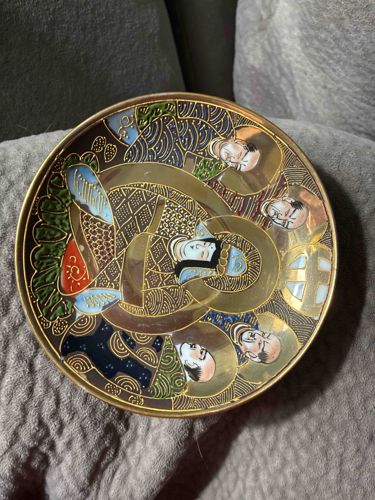
This is a small, round decorative plate, crafted in a style reminiscent of Japanese Satsuma ware, though without a clear mark to confirm. The plate features a finely detailed design with multiple figures, likely depicting Japanese scholars, deities, or noblemen, against a rich, ornate background. The primary colors used are deep blues, greens, reds, and black, accented heavily with intricate gold gilt work. The figures' faces are rendered with delicate features and pale skin tones, contrasting with their elaborately patterned robes. Surrounding the figures, the background is filled with traditional Japanese motifs such as geometric patterns, swirling clouds, and floral elements, all delineated in fine gold lines and dots, creating a brocade-like effect. The rim of the plate is also edged with a solid band of gold, showing some subtle wear consistent with handling or age. The construction appears to be ceramic or porcelain, covered with a thick glaze that gives the piece a glossy finish. There are no immediately visible cracks, chips, or significant repairs, suggesting it has been relatively well-preserved. However, some minor loss of gilt and possible surface abrasions may be present upon closer inspection, particularly in areas of high relief or intricate pattern. The craftsmanship is evident in the precise detailing of the figures' expressions and the complex patterns, indicating a good quality, decorative piece likely produced in the late 19th or early 20th century. The overall aesthetic is one of opulence and historical narrative, typical of export ware from that period designed to appeal to Western tastes for exotic oriental art.
AI Appraisal Report
Based on my visual examination of the provided image, this small, round decorative plate, styled in the manner of Japanese Satsuma ware, appears to be in good overall condition. I observe no obvious cracks, chips, or major repairs. There is some minor gilt loss noted on the rim and potentially in high-relief areas, consistent with age and handling, but this does not significantly detract from its aesthetic appeal. The detailed figural motifs, rich coloration, and intricate gold gilt work suggest a decorative piece of good quality, likely dating from the late 19th to early 20th century. Without a clear maker's mark and given its stylized nature, I assess it as 'Satsuma-style' rather than definitively true Satsuma ware, which impacts its value.
The market for decorative Japanese export ceramics, particularly unmarked Satsuma-style pieces, is moderate. Demand is generally from collectors of Asian decorative arts, but isn't as robust as for authenticated, signed Satsuma pieces from renowned kilns. Comparable sales for similar quality, unmarked Satsuma-style plates of this size typically fall within the identified range. Factors impacting value include the exceptional detail, good preservation, and appealing aesthetic. However, the lack of a definitive mark for authenticity and the 'style' designation prevent it from reaching higher price points reserved for verifiable Satsuma ware.
It is crucial to note the limitations of image-based appraisal. A thorough in-person examination would be necessary to verify the exact type of ceramic, confirm the absence of hairline cracks or subtle repairs, and assess gilt wear and surface abrasions more accurately. Furthermore, the absence of a clear mark means provenance documentation or scientific analysis of the materials would be needed to definitively confirm its origin and period of production, which could potentially elevate its authenticity and value significantly if proven to be of a known kiln or artist.