AI Appraisal Estimate

AI-generated estimates · not official valuations

From the user

What was submitted

Photo and notes provided by the user — not generated by AI

Submitted item photo
Submitted photo · June 25, 2026

User's notes

No additional notes provided.

AI analysis below

AI appraisal

AI analysis & estimate

AI-Generated · Verify before acting

Everything below is generated by AI for informational purposes only. AI can make mistakes — the AI may misidentify items or misattribute them (artist, maker, brand, designer, origin, era). This is not an official valuation and should not be used for insurance, sale, tax, estate, legal, or lending purposes — or any decision requiring a certified appraisal. It is not an authoritative claim about any person, brand, or rights holder — do not share or rely on it as a factual statement about a third party. Always consult qualified professionals before making financial decisions.

Read the full disclaimer

AI Identification

·Not independently authenticated·Verify before acting

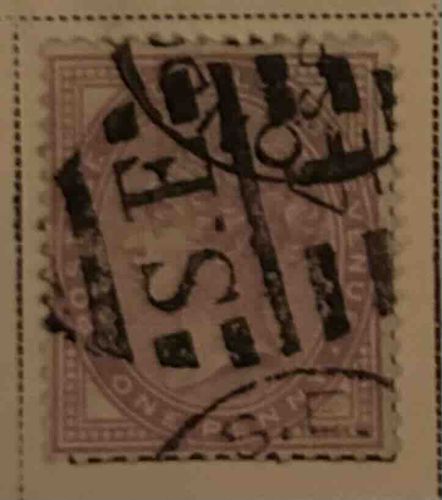
Used British Penny Lilac Stamp, C.S.E. Obliterated

Philatelic Stamp

AI Estimated Value

·Not an official valuation·Verify before acting

$50 - $100

As of June 25, 2026

AI Item Analysis

·AI can make mistakes·Verify before acting
This item is a used British Penny Lilac stamp, characterized by its distinctive pale brownish-purple or lilac color. The stamp features a central circular design with text that appears to read "ONE PENNY" along its lower edge. The outer border presents a rectangular frame with a perforated edge, indicating it was intended for postal use and separated from a sheet. A prominent black obliteration mark, which appears to be applied diagonally across the stamp, is visible. This cancellation consists of several thick, unevenly spaced horizontal bars, over which the letters "C.S.E." are clearly superimposed in a more defined, vertical alignment. The obliteration extends beyond the boundaries of the central circular design. The stamp exhibits signs of typical wear associated with a used postal item, including potential light creasing or handling marks, though the overall condition of the paper appears to be relatively stable. The perforations are present along all four sides, with some slight imperfections or missing 'teeth' visible on the top and right edges in the provided close-up images. The printing quality of the stamp itself seems good, with clear details, despite the heavy cancellation. The style and design suggest it belongs to the Victorian era, specifically associated with the 'Penny Lilac' issues which were widely used in Great Britain, dating the stamp to the late 19th century, likely between 1881 and 1901. The obliteration mark suggests it was processed through a postal system, adding to its historical context as a used artifact. The quality of the paper is standard for an antique stamp, and the discoloration inherent to its age is visible.

AI Appraisal Report

·AI can make mistakes·Verify before acting
This British Penny Lilac stamp, C.S.E. Obliterated, appears to be an authentic example from the Victorian era (1881-1901), based on the visual characteristics aligning with known Penny Lilac issues. The 'C.S.E.' obliteration is notable; these departmental cancellations often add interest, though not always significant value, depending on their rarity and clarity. The stamp's condition is fair to good, exhibiting typical wear for a used postal item of its age, including visible perforations (some missing teeth) and the expected discoloration. The heavy diagonal bar cancellation with super-imposed 'C.S.E.' is clear, which is a positive attribute for collectors of cancelled stamps. Market conditions for common Penny Lilac stamps, even with departmental cancellations, are generally stable but not exceptionally strong. While the Penny Lilac itself is a common issue, the specific C.S.E. cancellation could enhance its appeal to a niche market of collectors focusing on departmental cancels. However, without further research into the rarity of this particular type of C.S.E. cancellation, its impact on value is limited. Demand for such stamps is consistent among British Commonwealth collectors, but it is not considered a rare item. The primary factor impacting value here is the cancellation and the overall condition. The clear cancellation is a plus, but the general condition and the commonality of the underlying stamp prevent a high valuation. It is crucial to note that this appraisal is based solely on the provided image. For full authentication and a definitive valuation, a physical in-hand examination would be necessary to assess paper quality, watermarks (if any), gum condition (though not relevant for a used stamp), and microscopic details of the print and cancellation. Provenance documentation, if available, could also provide valuable historical context and further assurance of authenticity.

Get your items appraised

Instant estimates of your treasures with AI-powered appraisals

Browse More Appraisals