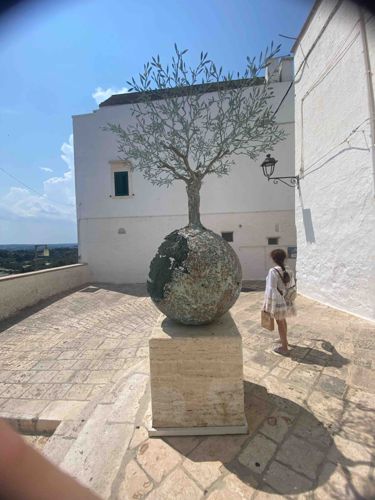
Hollow metallic tree statue, probably copper due to oxidation, on a stone podium in Locorotondo, Italy
These notes were written by the person who submitted this item. Appraiser.AI has not verified them, and the AI's identification and estimate may rely on them.
AI Estimated Value
Not an official valuation
$40,000-60,000
AI estimate as of August 15, 2025 · verify with a professional before acting
AI-Generated · Verify before acting
Everything on this page is generated by AI for informational purposes only. AI can make mistakes — the AI may misidentify items or misattribute them (artist, maker, brand, designer, origin, era). This is not an official valuation and should not be used for insurance, sale, tax, estate, legal, or lending purposes — or any decision requiring a certified appraisal. It is not an authoritative claim about any person, brand, or rights holder — do not share or rely on it as a factual statement about a third party. Always consult qualified professionals before making financial decisions.
This analysis also relies on unverified notes provided by the user, which may be incomplete or inaccurate and could affect the result.
This outdoor sculpture depicts an olive tree rising from a spherical, globe-like base, all mounted on a stone pedestal. The tree itself appears to be constructed from a metallic material, likely copper or bronze, given the visible green and turquoise oxidation (patina) across its surface, especially on the leaves and branches. The foliage is intricately detailed, with individual leaves formed to mimic the distinct shape of olive leaves, and an overall naturalistic branch structure. The trunk and branches show a lighter, more golden-brown hue in areas where the patina might be less developed or has been worn, suggesting the original metal color. The spherical base, upon which the tree is rooted, is also metallic and heavily patinated, with significant areas of green and dark brown oxidation, resembling an ancient, weathered globe or perhaps a stylized depiction of the Earth. There are darker, possibly corroded or distressed areas on its surface. The entire sculpture rests upon a robust, cubic pedestal made of light-colored, possibly travertine or limestone, with visible rough-hewn textures and natural variations in color. The pedestal shows some minor surface wear consistent with outdoor exposure but no significant damage. The overall construction suggests a hollow metallic fabrication for the tree and sphere, affixed securely to the solid stone base. The sculpture is a permanent outdoor installation, given its substantial nature and placement in what appears to be a public square or elevated viewpoint in Locorotondo, Italy. Its style is contemporary yet pays homage to traditional Italian symbolism, particularly the olive tree, which is culturally significant. The craftsmanship appears to be of high quality, with attention to detail in the tree's form and the sturdy construction of the base.
AI Appraisal Report
Based on my visual examination of the images, this outdoor sculpture, an 'Olive Tree Sculpture on Stone Pedestal,' appears to be in very good condition consistent with its outdoor placement. The green and turquoise patina on the metallic tree and sphere strongly suggests a copper or bronze alloy, which is common and desired for outdoor public art due to its durability and aesthetic aging. The naturalistic details of the tree and the robust stone pedestal indicate quality craftsmanship. The stone pedestal shows minor weathering but no significant structural damage.
In terms of market conditions, large-scale, well-crafted public art pieces, especially those with local cultural significance like the olive tree in Italy, hold substantial value. Comparables for such installations would include commissioned metallic sculptures by established artists, often ranging from tens of thousands to hundreds of thousands of dollars depending on scale, artist's reputation, and material. While this piece is not explicitly attributed to a known artist, its prominent placement in Locorotondo indicates it may have been a commissioned work or a significant donation.
Demand for permanent outdoor installations remains steady, particularly for works that complement their surroundings and possess symbolic importance. The rarity here lies in its unique design and specific cultural context. Factors significantly impacting value include its substantial size, the durable materials (metallic tree, stone pedestal), its apparent artistic quality, and its public installation setting. The patina, while a natural aging process, adds to its aesthetic appeal and perceived antiquity.
It is crucial to note the limitations of remote appraisal. While the images are clear, I cannot definitively verify the authenticity of the material (e.g., precise copper alloy content) or the internal construction (hollow vs. solid) without a physical inspection. An in-person examination would allow for tactile assessment, a more thorough examination for structural integrity, and potential material testing. Provenance documentation, such as artist's records, commission agreements, or acquisition papers, would be essential for full authentication and could significantly impact the valuation, especially if attributed to a known sculptor. Without such documentation, the appraisal relies solely on the visible characteristics.