AI estimate as of August 31, 2025 · verify with a professional before acting
AI-Generated · Verify before acting
Everything on this page is generated by AI for informational purposes only. AI can make mistakes — the AI may misidentify items or misattribute them (artist, maker, brand, designer, origin, era). This is not an official valuation and should not be used for insurance, sale, tax, estate, legal, or lending purposes — or any decision requiring a certified appraisal. It is not an authoritative claim about any person, brand, or rights holder — do not share or rely on it as a factual statement about a third party. Always consult qualified professionals before making financial decisions.
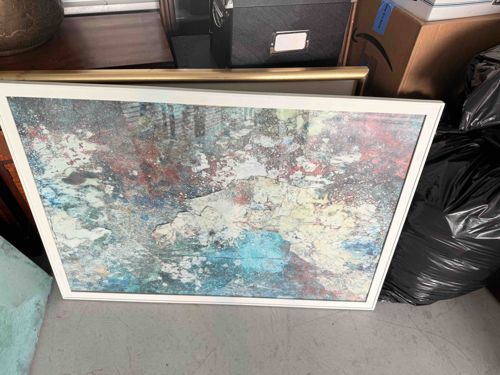
This item is a framed abstract print or painting, characterized by a dynamic and textured composition. The dominant colors include various shades of blue, teal, red, white, and muted earthy tones, creating a mottled, almost distressed or urban aesthetic. The texture within the artwork itself appears to simulate worn surfaces, possibly with elements resembling peeling paint or rough concrete, suggestive of an industrial or street art influence. The piece is housed within a plain white, presumably wooden or composite, frame that features a clean, simple profile. The wide, flat edges of the frame provide a contemporary border to the artwork. The dimensions appear to be rectangular, with the longer side being horizontal. There's a visible sheen on the surface, indicating the presence of glass or acrylic glazing protecting the artwork underneath. Given the apparent lack of brushstrokes visible through the glass and the uniform application of some of the background colors, it is likely a print (e.g., giclée or lithograph) rather than an original painting, designed to mimic a textured surface. No distinct artist's signature, edition number, or maker's marks are discernible from the image. The style suggests a modern or contemporary period, likely post-1970s. The overall condition appears good from the visible angle, with no obvious signs of damage to the frame or the artwork itself, although light reflections on the glass make it difficult to ascertain minute details of the print's surface. The simplicity of the frame suggests a focus on the abstract imagery within.
AI Appraisal Report
Based on my visual examination of the provided image, this Framed Abstract Textured Wall Art appears to be in good condition. The frame is clean and shows no obvious damage. The artwork itself, protected by glazing, also appears free from visible defects, although reflections obscure some surface details. Authenticity, however, is a key limitation from an image-based appraisal. The lack of visible brushstrokes and the uniform texture strongly suggest this is a mass-produced print, rather than an original painting. It's designed to emulate a textured, distressed aesthetic commonly found in modern decor.
In terms of market conditions, this type of abstract print is widely available through various retailers, including home goods stores, online art marketplaces, and furniture outlets. Comparable items, often referred to as 'decorative art,' typically range from $50 to $200 for similar sizes and framing quality. Demand for such pieces is generally steady for home decor purposes, but they lack rarity due to their replicable nature. Factors significantly impacting value are primarily its decorative appeal and condition; collectibility is virtually non-existent. The absence of an artist's signature or edition number further supports its classification as decorative art with limited intrinsic value beyond its aesthetic contribution to a space.
For full authentication and to definitively rule out the possibility of an original, an in-person examination would be critical to assess actual surface texture, observe brushwork (if any), and look for any hidden signatures, edition marks, or gallery labels on the reverse. Provenance documentation (e.g., purchase receipts, artist's certificates) would also be essential to confirm its origin and artist. Without these, it remains broadly categorized as a decorative print.