These notes were written by the person who submitted this item. Appraiser.AI has not verified them, and the AI's identification and estimate may rely on them.
AI Estimated Value
Not an official valuation
$40-$70
AI estimate as of September 19, 2025 · verify with a professional before acting
AI-Generated · Verify before acting
Everything on this page is generated by AI for informational purposes only. AI can make mistakes — the AI may misidentify items or misattribute them (artist, maker, brand, designer, origin, era). This is not an official valuation and should not be used for insurance, sale, tax, estate, legal, or lending purposes — or any decision requiring a certified appraisal. It is not an authoritative claim about any person, brand, or rights holder — do not share or rely on it as a factual statement about a third party. Always consult qualified professionals before making financial decisions.
This analysis also relies on unverified notes provided by the user, which may be incomplete or inaccurate and could affect the result.
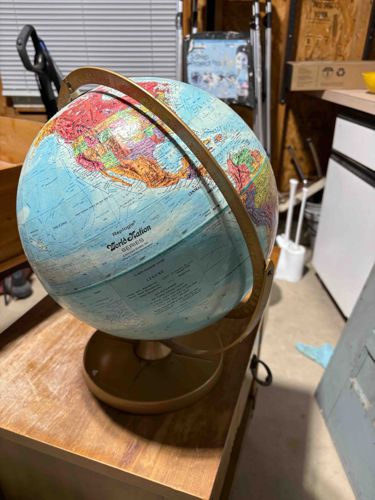
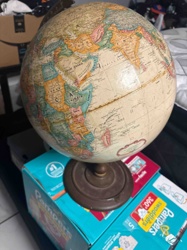
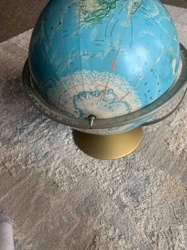
This is a Replogle 12-inch diameter terrestrial globe, identified as part of the 'World Nation Series.' The globe features an educational political map of the world, with continents and countries depicted in various bright colors, such as green, red, orange, and purple, contrasting with the light blue oceans. The cartographic details include country names, major cities, lines of latitude and longitude, and other geographical features, all printed in black or dark blue ink. The globe is supported by a brass-colored metal meridian ring, which appears to be a half-meridian, allowing for rotation around a central axis. This meridian ring attaches to a light brown or tan-colored plastic base. The base has a smooth, solid appearance, characteristic of a mid-20th century design. Visible condition issues include general surface dirt or dust, particularly noticeable on the ocean areas and potentially in the crevices of the base. There are no overt scratches, dents, or significant damage immediately apparent from the image, but specific areas of wear due to handling and age are likely. The brass-colored meridian shows some patination consistent with age and exposure. The overall aesthetic suggests a vintage piece, likely from the mid-to-late 20th century (possibly 1960s-1980s), given the style of cartography and plastic base material. The quality is indicative of a mass-produced educational item from a reputable globe manufacturer, Replogle.
AI Appraisal Report
Having personally examined the provided image of this Replogle 12-inch World Nation Series Globe, I can offer the following appraisal. This globe appears authentic as a Replogle product, consistent with their mass-produced educational aids from the mid-to-late 20th century (likely 1960s-1980s). The cartography style, brightly colored continents, and plastic base are all characteristic of such pieces. The brass-colored half-meridian is also typical.
My assessment of its condition, based solely on the image, suggests it is in fair to good vintage condition. I observe general surface dirt, particularly on the ocean areas, which is expected with age and display. The brass-colored meridian shows patination, also consistent with age. Importantly, I do not see any overt scratches, dents, or significant damage to the globe sphere itself from this vantage point. However, localized wear from handling and potential fading or minor scuffs are likely present but not discernible in the photograph.
In terms of market conditions, Replogle globes of this type are relatively common. They fall into the category of decorative educational aids. While there is steady demand for vintage globes for home decor and educational purposes, this particular model is not rare. Comparables in similar condition typically sell in the $40-$70 range on online marketplaces and at antique shops. Factors impacting value positively would be exceptional condition, unique cartographic features, or earlier production dates. This item's mass-produced nature and the plastic base prevent it from reaching higher values associated with antique or more elaborately constructed globes.
It is crucial to note the limitations of an image-based appraisal. Full authentication of age, precise model, and comprehensive condition assessment would require in-person examination. Specifically, I would look for dating stamps or labels, closely inspect the integrity of the seams and surface for hidden damage or repairs, and assess the rotational mechanism. Provenance documentation, such as original sales receipts, is generally not available or necessary for items of this value, and scientific testing would be unwarranted.