AI estimate as of September 1, 2025 · verify with a professional before acting
AI-Generated · Verify before acting
Everything on this page is generated by AI for informational purposes only. AI can make mistakes — the AI may misidentify items or misattribute them (artist, maker, brand, designer, origin, era). This is not an official valuation and should not be used for insurance, sale, tax, estate, legal, or lending purposes — or any decision requiring a certified appraisal. It is not an authoritative claim about any person, brand, or rights holder — do not share or rely on it as a factual statement about a third party. Always consult qualified professionals before making financial decisions.
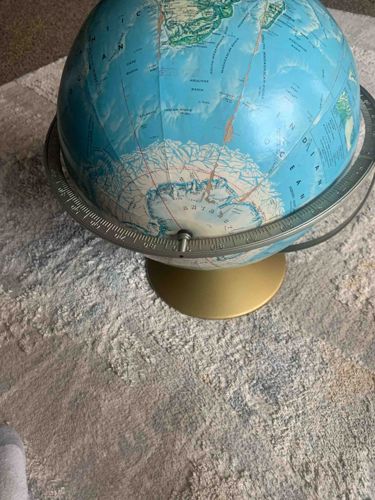
This item is a terrestrial globe, likely a desktop or table-top model, featuring a light blue ocean coloration with green and light brown landmasses, indicating a physical map style. The globe is mounted on a small, circular, brass-colored metal base, which appears to be a separate component but integrated into the stand. A half-meridian ring, made of a silvery-grey metal (possibly aluminum or nickel-plated steel), encircles the globe, serving as a degree indicator for latitude. This meridian ring is clearly marked with numerical graduations, likely indicating degrees, and is attached to the base. The globe surface itself shows various geographical names, such as 'INDIAN OCEAN' and 'ANTARCTICA,' with visible topographical or relief mapping, particularly in mountainous regions like the Himalayas. The condition of the globe appears to be fair; there are visible scuffs, scratches, and possibly some surface discoloration or wear consistent with age and regular handling. Some of the blue ocean coloring shows signs of fading or inconsistency in tone. The overall construction suggests it is made of a composite material for the globe sphere itself, possibly paper-mache or plastic, with metal for the base and meridian. Based on the geopolitical boundaries and visible names, it appears to be from the mid to late 20th century. There are no obvious maker's marks or signatures visible in the provided image, but further inspection would be required to determine specific manufacturing details or date of production. The quality of craftsmanship appears utilitarian, reflecting a functional educational tool that also serves as a decorative piece.
AI Appraisal Report
Based on my visual examination of the provided image, this terrestrial globe appears to be a mid-to-late 20th-century educational tool and decorative object. Its light blue ocean and relief mapping for landmasses are characteristic of globes from that era. The brass-colored metal base and silvery half-meridian, marked with numerical graduations, are consistent with standard manufacturing practices for such items.
The condition, unfortunately, significantly impacts its value. I observe visible scuffs, scratches, and apparent surface discoloration or wear, particularly on the blue ocean areas, suggesting fading or inconsistent tone. This wear is consistent with age and regular handling. The utilitarian craftsmanship further points to its function rather than high collectible art.
In terms of market conditions, vintage globes, especially those without notable makers or particularly unique features, occupy a niche market. Comparables for common educational globes from the latter half of the 20th century in fair condition typically range from $50 to $150. While there's steady demand for decorative vintage globes, this specific item does not possess the rarity or exceptional quality that would command a premium. Factors like geographical accuracy (based on borders shown) might appeal to some, but the condition is the primary limiting factor.
My authenticity assessment is based solely on visual cues; the construction materials, style, and visible geopolitical boundaries are consistent with its presumed age. However, a full authentication would require in-person examination to verify material composition (e.g., distinguishing plastic from paper-mache), assess the extent of surface degradation beyond what is visible in the image, and search for any obscured maker's marks or date stamps. Provenance documentation, if available, would also be invaluable, though less common for mass-produced educational items like this.