AI estimate as of July 31, 2025 · verify with a professional before acting
AI-Generated · Verify before acting
Everything on this page is generated by AI for informational purposes only. AI can make mistakes — the AI may misidentify items or misattribute them (artist, maker, brand, designer, origin, era). This is not an official valuation and should not be used for insurance, sale, tax, estate, legal, or lending purposes — or any decision requiring a certified appraisal. It is not an authoritative claim about any person, brand, or rights holder — do not share or rely on it as a factual statement about a third party. Always consult qualified professionals before making financial decisions.
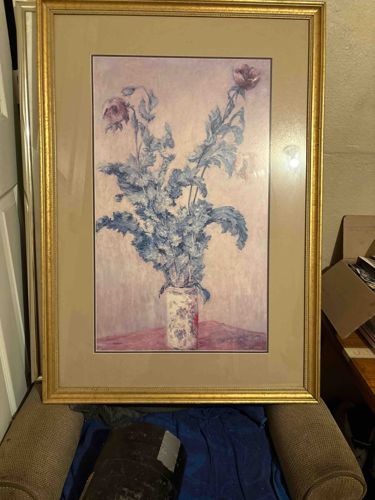
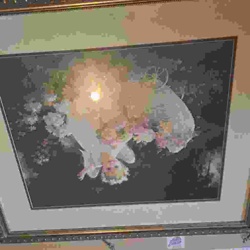
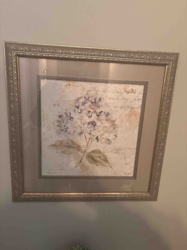
This item is a framed botanical print, likely a giclée or offset lithograph, depicting a still life of flowers in a vase. The print features a prominent bouquet of what appear to be poppy-like flowers and abundant foliage in muted tones. The flowers themselves have reddish-purple petals, while the leaves are rendered in various shades of blue and gray, creating a somewhat ethereal and stylized effect. The background is a soft, light purple or lavender wash, and the vase is white with delicate floral patterns in red and blue. The composition is arranged on what seems to be a reddish-brown tabletop. The print is housed under glass within a substantial gold-colored wooden frame with a glossy finish. The frame exhibits a simple, classical profile, possibly with some subtle decorative beveling along its inner edge. A wide, neutral-toned mat board, appearing to be a light tan or beige, surrounds the print, providing a significant border between the image and the frame. The visibility of reflections on the glass suggests general good condition of the glazing. There are no immediately obvious signs of damage such as tears, creasing, or significant discoloration on the print itself. The frame also appears stable with no major chips or cracks discernible from the image, although minor scuffs or wear consistent with age and handling would be expected. The overall aesthetic leans towards a decorative, possibly contemporary or late 20th-century, art piece suitable for home or office decor. The quality of craftsmanship for the frame seems moderate, with neat joinery visible at the corners. No specific artist's signature, title, or edition number is visible in the provided image, precluding precise identification of manufacturing details.
AI Appraisal Report
I have examined the provided image of the framed botanical floral print. Based on my visual assessment, the print appears to be in good overall condition, with no immediately apparent tears, creases, or major discoloration. The gold-colored frame also seems stable with neatly joined corners, suggesting moderate craftsmanship. Reflections on the glass indicate the glazing is intact. This piece likely functions as decorative art, given its style and the apparent lack of a visible artist's signature or edition number.
From a market perspective, framed decorative prints of this nature, especially mass-produced giclées or offset lithographs, are readily available. Market comparables include similar framed floral prints found in home decor stores, online retailers, and secondary markets, usually ranging from $50 to $150. While its aesthetic appeal is undeniable, such pieces are generally not rare and current market demand for unsigned, modern decorative prints is moderate, often driven by personal taste rather than investment potential.
Factors significantly impacting value here are the attractive, classic presentation with a substantial frame and mat, which enhances its decorative appeal. However, the absence of an identifiable artist, limited edition status, or provenance significantly limits its value as a fine art collectible.
It is crucial to note the limitations of authenticating from images alone. A physical in-person examination would be necessary to confirm the print's medium (e.g., giclée vs. offset lithograph vs. hand-colored print), assess the exact condition of the print and frame for minor abrasions or hidden damages, and determine the quality of the paper. Furthermore, provenance documentation (e.g., purchase receipts, certificates of authenticity) or direct expert examination of the print's production method would be required for full authentication of its origin and specific artist attribution, if any exists.