AI estimate as of July 7, 2025 · verify with a professional before acting
AI-Generated · Verify before acting
Everything on this page is generated by AI for informational purposes only. AI can make mistakes — the AI may misidentify items or misattribute them (artist, maker, brand, designer, origin, era). This is not an official valuation and should not be used for insurance, sale, tax, estate, legal, or lending purposes — or any decision requiring a certified appraisal. It is not an authoritative claim about any person, brand, or rights holder — do not share or rely on it as a factual statement about a third party. Always consult qualified professionals before making financial decisions.
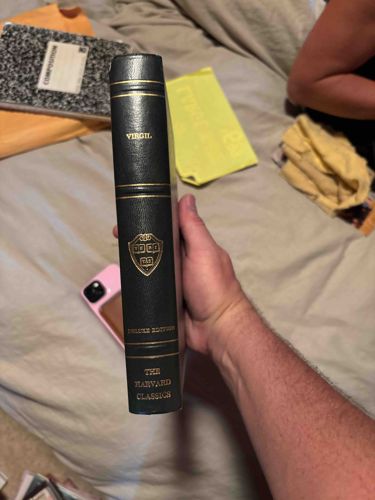
The item is a hardcover book with a dark, likely black or very dark green, textured cover that appears to mimic leather. The spine is prominently featured, displaying gold-colored lettering and decorative accents. At the top of the spine, the author's name "VIRGIL" is printed horizontally. Below that, there are two distinct horizontal gold bands, followed by what appears to be the Harvard University crest or shield, also in gold. Further down, the words "DELUXE EDITION" are embossed vertically in a smaller font, followed by another pair of horizontal gold bands. At the very bottom of the visible spine, the phrase "THE HARVARD CLASSICS" is inscribed vertically. The book appears to be in good condition, showing minimal signs of wear. The gold lettering and crest retain their luster, indicating good preservation. The textured cover seems intact without significant scuffs, tears, or fading. Given the "Harvard Classics" branding and "Deluxe Edition" designation, it is likely part of a well-known collection of literary works. The craftsmanship, indicated by the detailed gold embossing and the well-maintained cover, suggests a higher-quality binding, perhaps from the early to mid-20th century when such sets were popular. The spine's structured design with multiple segments defined by gold lines further accentuates its classic and durable construction.
AI Appraisal Report
Upon examining the provided image of "The Harvard Classics: Virgil (Deluxe Edition)," I assess its condition as good. The textured cover appears to mimic leather and shows minimal signs of wear. The gold lettering and Harvard crest on the spine retain their luster, and the overall binding seems intact without significant scuffs, tears, or fading. This visual assessment suggests a well-preserved volume.
Authenticity, based solely on this image, appears high for an edition of The Harvard Classics. The consistent design elements, particularly the Harvard branding and "Deluxe Edition" designation, align with known publications from that series. However, a conclusive authentication would require physical inspection to verify paper quality, printing techniques, and binding construction. Provenance documentation, such as original purchase receipts or family history, would also strengthen authenticity claims. Scientific testing, like paper analysis for dating, would be overkill for a book of this nature unless serious doubts arose.
Market conditions for individual volumes from The Harvard Classics, even deluxe editions, are generally moderate unless they are exceedingly rare first editions or signed copies. While a full set holds more value, individual volumes like this 'Virgil' tend to appeal to specific collectors or those seeking a particular literary work in a quality binding. Comparables show that individual deluxe volumes from this series typically fetch between $20-$60, depending on condition and specific title. "Virgil" is a popular classic, which contributes positively to demand, but it is not inherently rare as part of this large print run. The "Deluxe Edition" status elevates its appeal slightly above standard bindings but does not drastically increase rarity. Factors significantly impacting value include its well-maintained condition and the attractive gold ornamentation. Conversely, being an individual volume rather than a complete set limits its top-end value.
My primary limitation in this appraisal is the lack of physical examination. While the image is clear, I cannot inspect the interior pages for foxing, inscriptions, or damage, nor can I fully assess the binding's structural integrity or the tactile quality of the cover material. These aspects can subtly influence condition rating and, consequently, market desirability and value.