AI estimate as of September 12, 2025 · verify with a professional before acting
AI-Generated · Verify before acting
Everything on this page is generated by AI for informational purposes only. AI can make mistakes — the AI may misidentify items or misattribute them (artist, maker, brand, designer, origin, era). This is not an official valuation and should not be used for insurance, sale, tax, estate, legal, or lending purposes — or any decision requiring a certified appraisal. It is not an authoritative claim about any person, brand, or rights holder — do not share or rely on it as a factual statement about a third party. Always consult qualified professionals before making financial decisions.
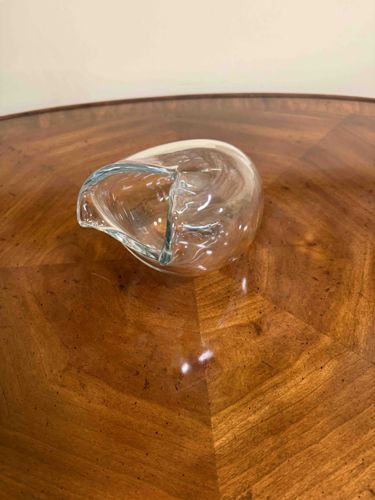
This item is a clear glass pourer or small decanter, characterized by its smooth, organic, and somewhat amorphous shape. It appears to be made from high-quality, clear, hand-blown or molded glass, exhibiting excellent optical clarity with no visible inclusions or significant air bubbles, indicating good craftsmanship. The primary body of the piece is bulbous and rounded, tapering towards one end into a gracefully curved spout. The spout's opening is elongated and gently flared, designed for ease of pouring. The top edge of the spout features a subtle, almost unnoticeable rim, suggesting either a very finely finished edge or part of the molding process. The overall form suggests a biomorphic design, possibly mid-20th century to contemporary, emphasizing fluidity and minimal lines. The glass itself is colorless and highly reflective, catching and refracting ambient light beautifully. There are no discernible markings, signatures, or maker's marks visible from the provided angle. The surface appears to be in excellent condition, with no immediate indications of chips, cracks, repairs, or significant wear such as scratches or cloudiness. The piece feels substantial, owing to the thickness of the glass, contributing to its perceived quality and durability. Its unique shape, particularly the integrated and dynamic spout, is its most distinguishing feature, setting it apart from more traditional pitchers or decanters. Its function could range from serving beverages like creamer, syrup, or olive oil, to being a decorative art piece on its own.
AI Appraisal Report
Upon my virtual examination of this clear glass pourer/decanter, I find its condition to be excellent based solely on the provided image. There are no visible chips, cracks, repairs, or significant surface wear such as cloudiness or deep scratches. The optical clarity and absence of notable inclusions suggest good quality glass and craftsmanship, possibly hand-blown. The fluid, biomorphic design is contemporary or mid-20th century in style.
Authenticity verification from images alone is limited. While the form appears well-executed, I cannot definitively confirm its origin, manufacturing process (hand-blown vs. molded with hand-finishing), or designer/maker without a physical examination. An in-person inspection would allow me to assess the weight, feel the texture, identify any subtle mold lines, and search for extremely faint maker's marks or pontil marks that might not be visible in photographs. Provenance documentation, such as original sales receipts, designer certificates, or exhibition records, would be crucial for attributing it to a specific artist or manufacturer. Scientific testing, like glass composition analysis, is not typically performed for items of this nature unless there are strong claims of high-value artistic or historical significance.
Regarding market conditions, similar unauthenticated, well-designed contemporary glass pourers by lesser-known artists or manufacturers typically fetch in the $150-250 range. If this piece could be definitively attributed to a renowned designer (e.g., Alvar Aalto, Tapio Wirkkala) or a significant design house, or confirmed as a rare limited-production piece, its value could increase substantially. However, without such identification, uniqueness alone, while aesthetically pleasing, does not significantly drive rarity or demand in a broad market. The demand for visually appealing, functional glass items remains steady for decorative purposes or practical use, but its generic origin currently limits higher valuation.