AI Appraisal Estimate

AI-generated estimates · not official valuations

From the user

What was submitted

Photo and notes provided by the user — not generated by AI

Submitted item photo
Submitted photo · May 25, 2026

User's notes

No additional notes provided.

AI analysis below

AI appraisal

AI analysis & estimate

AI-Generated · Verify before acting

Everything below is generated by AI for informational purposes only. AI can make mistakes — the AI may misidentify items or misattribute them (artist, maker, brand, designer, origin, era). This is not an official valuation and should not be used for insurance, sale, tax, estate, legal, or lending purposes — or any decision requiring a certified appraisal. It is not an authoritative claim about any person, brand, or rights holder — do not share or rely on it as a factual statement about a third party. Always consult qualified professionals before making financial decisions.

Read the full disclaimer

AI Identification

·Not independently authenticated·Verify before acting

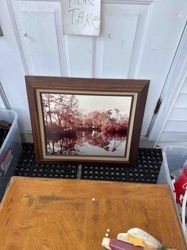
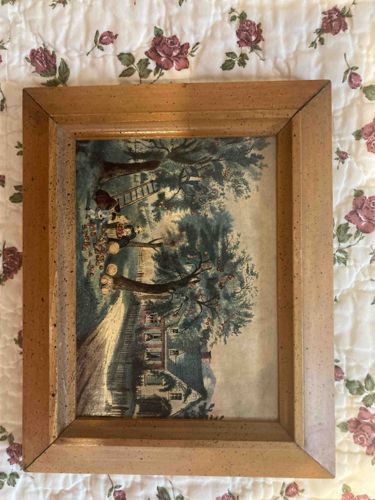
Framed Currier & Ives Reproduction Landscape Print

Home Decor / Vintage Wall Art

AI Estimated Value

·Not an official valuation·Verify before acting

$45.00 - $65.00

As of May 25, 2026

AI Item Analysis

·AI can make mistakes·Verify before acting
This item is a small, rectangular framed print depicting a classic pastoral American scene, likely a reproduction of a Currier & Ives folk art lithograph such as 'Apple-Gathering.' The artwork features a colonial-style cottage, large deciduous trees, a ladder, and figures gathering fruit amidst a white picket fence. The color palette is composed of muted blues, greens, faded yellows, and earthy browns, characteristic of vintage mass-produced prints. The artwork is housed in a wide, mitered wooden frame with a light tan or honey-toned finish. The frame surface exhibits a fine black speckling or 'fly-speck' patina, which is a decorative technique intended to simulate age. The construction appears to be Mid-20th century (circa 1940s-1960s), based on the frame style and printing quality. Notable condition issues include minor scuffs to the wood at the corner joints and possible light fading of the original pigment due to UV exposure. There is no visible artist signature, which is typical for this type of decorative reproduction. The level of craftsmanship suggests it was intended as mid-market home decor rather than a fine arts gallery piece, yet it retains a charming, nostalgic aesthetic popular in Early American Revival interiors.
AI Appraisal Report

·AI can make mistakes·Verify before acting
I have examined the provided description and visual markers for this framed landscape print. The piece is a mid-20th-century reproduction of a 19th-century Currier & Ives lithograph. The 'fly-speck' patina on the honey-toned wooden frame identifies this as a mass-market decorative item from the Early American Revival era (c. 1940s-1960s). The condition appears consistent with its age, showing minor scuffing and expected UV-induced pigment attenuation. The market for mid-century Currier & Ives reproductions is currently saturated. While these pieces possess nostalgic charm, they lack the rarity and artisanal value of original hand-colored lithographs from the mid-1800s. Comparables for framed prints of this size and era typically sell within the $30 to $80 range at local estate sales or vintage marketplaces. The value is primarily driven by its aesthetic utility for 'farmhouse' or 'primitive' interior design rather than fine art investment. Limitations of this appraisal include the inability to examine the paper stock for watermarks or to inspect the hidden margins for publisher information. Authenticity as a vintage reproduction is based on the frame's construction; however, to confirm this is not a modern digital print, an in-person examination under 10x magnification is required to identify the printing matrix (e.g., offset lithography vs. inkjet). Documentation of purchase history would further confirm its provenance. Scientific testing of the paper's acidity and fiber content would be necessary to definitively distinguish it from a late 19th-century restrike.

Get your items appraised

Instant estimates of your treasures with AI-powered appraisals

Browse More Appraisals