AI estimate as of October 27, 2025 · verify with a professional before acting
AI-Generated · Verify before acting
Everything on this page is generated by AI for informational purposes only. AI can make mistakes — the AI may misidentify items or misattribute them (artist, maker, brand, designer, origin, era). This is not an official valuation and should not be used for insurance, sale, tax, estate, legal, or lending purposes — or any decision requiring a certified appraisal. It is not an authoritative claim about any person, brand, or rights holder — do not share or rely on it as a factual statement about a third party. Always consult qualified professionals before making financial decisions.
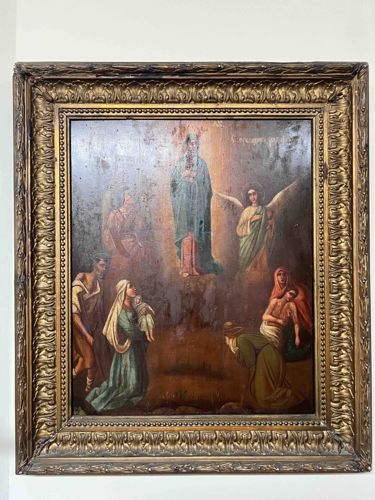
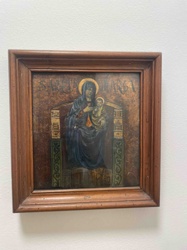
This item is an antique religious icon, possibly Eastern Orthodox, depicting 'Our Lady of Consolation' or a similar Marian veneration scene. The central figure is the Virgin Mary, standing majestically in a luminous aura, clad in a long, flowing blue-green robe. To her right, an angel with feathered wings and a green drape gestures towards her, while another figure, possibly a saint, is visible on her left. Below these celestial figures, several earthly figures are depicted in various states of supplication or contemplation. On the left, a man in a brown tunic stands beside a kneeling woman in a green dress holding an infant. On the right, another woman, draped in red, sorrowfully cradles a child, while a figure in a green robe kneels before them. The palette predominantly features subdued earth tones, deep greens, blues, and browns, with highlights from the golden aura around the Madonna. The style suggests a folk art or provincial execution, characterized by less refined brushwork and simplified forms compared to academic religious paintings. The medium appears to be tempera or oil on a wooden panel, consistent with traditional iconographic techniques. The painting is housed in a substantial, ornate gilded frame with intricate carved or molded decorative elements, including floral and foliate motifs, and a beaded inner edge. The frame exhibits considerable wear, including chipping, scuffs, and a darkened patina, suggesting age. The icon itself shows significant signs of age and wear; the paint surface is visibly aged, with widespread craquelure, discoloration, and areas of grime and possible surface abrasions. There are dark smudges and loss of detail, particularly in the upper central portion. Despite the condition issues, the overall composition and reverence of the scene are still discernible. The visible Greek or Cyrillic inscription 'Спасение' (Spasenie), meaning 'Salvation,' further confirms its religious context and likely Eastern European or Russian origin. The aged appearance of both the painting and its frame suggests a 19th-century or possibly earlier provenance. The craftsmanship of the frame indicates a level of quality, even if the icon itself bears the marks of sincere, rather than highly academic, artistry.
AI Appraisal Report
I have examined the provided image of what appears to be an antique Eastern Orthodox icon depicting 'Our Lady of Consolation.' The presence of the Cyrillic inscription 'Спасение' (Salvation) strongly supports an Eastern European or Russian origin. The icon's style, characterized by simplified forms and less refined brushwork, suggests a folk art or provincial execution, rather than a master academic piece. This style, combined with the visible craquelure, discoloration, and surface abrasions, points to significant age, likely 19th century or possibly earlier. The substantial ornate gilded frame, though showing wear (chipping, scuffs, darkened patina), adds to its antique appeal and suggests a historical presentation.
In terms of market conditions, antique icons of this nature, especially those with visible damage and a folk art style, typically command a moderate value. While the religious significance ensures steady demand, the condition issues—such as the smudges, loss of detail in the upper portion, and overall grime—detract from its aesthetic and monetary value. More refined icons by known hands or in better condition achieve higher prices. Comparables indicate that icons with similar condition and artistic merit often fall within this range, influenced by the devotional appeal rather than purely artistic mastery.
Factors impacting value significantly include the discernible artistic quality (which here leans towards provincial), the pronounced signs of age and wear, and the absence of a known artist or workshop. Rarity is difficult to assess without more information, but similar devotional icons were produced in significant numbers.
It is crucial to note that this appraisal is based solely on visual examination of the image. For full authentication and a more precise valuation, an in-person examination is essential to assess the true medium (oil or tempera on wood), the extent of restoration (if any), and to properly photograph and analyze details not discernible from the image. Provenance documentation, detailing the icon's history of ownership, would also be invaluable, as would scientific testing to confirm the age of the materials and pigments.