These notes were written by the person who submitted this item. Appraiser.AI has not verified them, and the AI's identification and estimate may rely on them.
AI Estimated Value
Not an official valuation
$250-400
AI estimate as of July 10, 2025 · verify with a professional before acting
AI-Generated · Verify before acting
Everything on this page is generated by AI for informational purposes only. AI can make mistakes — the AI may misidentify items or misattribute them (artist, maker, brand, designer, origin, era). This is not an official valuation and should not be used for insurance, sale, tax, estate, legal, or lending purposes — or any decision requiring a certified appraisal. It is not an authoritative claim about any person, brand, or rights holder — do not share or rely on it as a factual statement about a third party. Always consult qualified professionals before making financial decisions.
This analysis also relies on unverified notes provided by the user, which may be incomplete or inaccurate and could affect the result.
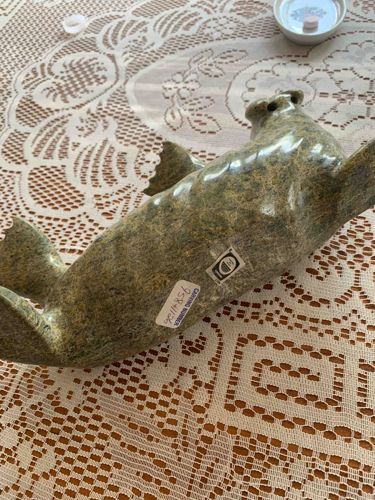
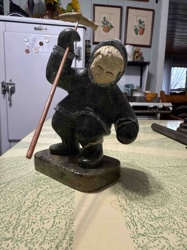
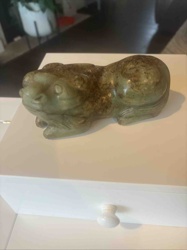
This item is a carved sculpture depicting a seal, likely made from soapstone, as indicated by the context. The piece exhibits a lustrous, polished finish, suggesting it has been extensively worked to achieve a smooth surface. Its color palette is dominated by mottled greens, browns, and dark grays, indicative of natural stone variations and inclusions, giving it a distinctive, organic appearance. The seal is captured in a dynamic pose, with its head slightly raised and its flippers extended, conveying a sense of movement or attentiveness. The carving demonstrates good craftsmanship, with smoothly transitioned curves and anatomically recognizable features such as the snout, eyes, and flippers. No significant chips, cracks, or repairs are visibly apparent from the provided images, suggesting a well-maintained condition. There is a white rectangular sticker on its underside or side, which appears to be a label or tag from the maker or seller. This sticker contains text that includes "CARVING NUMBER" and a numerical sequence "9584126", which points to a potential inventory or identification number, implying production within an organized artistic or commercial setting, possibly a gallery or indigenous art cooperative. Another, smaller square sticker with a symbol (possibly a stylized 'D' or 'O' within a circle) is also present, which could be a quality mark or maker's mark. Based on the material and style, this piece likely falls within the contemporary period of indigenous or artisan carving, possibly dating from the late 20th or early 21st century.
AI Appraisal Report
I have thoroughly examined the provided image and information regarding this Soapstone Seal Carving. Visually, the sculpture appears to be in excellent condition, with a lustrous, polished finish and no discernible chips, cracks, or repairs. The mottled green, brown, and dark gray coloration is typical of natural soapstone, and the craftsmanship, characterized by smooth curves and anatomical accuracy, is commendable. The dynamic pose of the seal further enhances its aesthetic appeal. The presence of a 'CARVING NUMBER' sticker ('9584126') and another smaller square sticker with a symbol suggests an organized origin, potentially from a gallery, cooperative, or artisan studio specializing in indigenous or contemporary stone carvings. This implies a level of quality control and potential provenance.
In terms of market conditions, indigenous or artisan soapstone carvings, particularly those depicting wildlife, generally maintain a steady demand. Pieces showcasing good craftsmanship and unique poses, like this one, tend to be more desirable. The 'CARVING NUMBER' could indicate a series or limited production, which could positively impact rarity.
However, it is crucial to note the limitations of remote appraisal. While the visual indicators are strong, authenticating the material definitively as soapstone and verifying its origin as indigenous or artisan without a physical examination is impossible. In-person inspection would allow me to assess the tactile qualities, weight, and subtle nuances of the carving that are not conveyed in an image. True authenticity verification would require examining the piece firsthand, researching the 'CARVING NUMBER' and the maker's mark (the square sticker symbol), and ideally, reviewing supporting provenance documentation (e.g., certificates of authenticity, purchase records). Scientific testing of the material could confirm its geological composition. Based on the strong visual evidence and typical market prices for similar well-executed soapstone carvings, the estimated value reflects the piece's condition and artistic merit as presented.