These notes were written by the person who submitted this item. Appraiser.AI has not verified them, and the AI's identification and estimate may rely on them.
AI Estimated Value
Not an official valuation
$20-40
AI estimate as of November 2, 2025 · verify with a professional before acting
AI-Generated · Verify before acting
Everything on this page is generated by AI for informational purposes only. AI can make mistakes — the AI may misidentify items or misattribute them (artist, maker, brand, designer, origin, era). This is not an official valuation and should not be used for insurance, sale, tax, estate, legal, or lending purposes — or any decision requiring a certified appraisal. It is not an authoritative claim about any person, brand, or rights holder — do not share or rely on it as a factual statement about a third party. Always consult qualified professionals before making financial decisions.
This analysis also relies on unverified notes provided by the user, which may be incomplete or inaccurate and could affect the result.
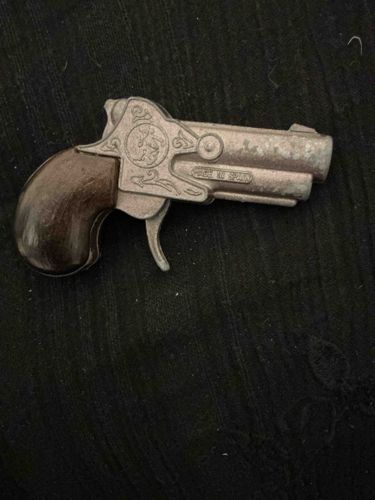
This item is a vintage die-cast toy pistol, specifically designed to resemble a derringer. It features a metallic silver/grey finish with an aged and somewhat mottled appearance, indicative of a zinc alloy or similar pot metal construction. The grip is molded to mimic dark wood grain, adding a touch of faux realism to the toy. The overall size appears to be quite small, consistent with a derringer type, likely fitting comfortably in a child's hand. Notable features include decorative scrollwork on the side plate of the 'receiver' portion, which surrounds a central emblem that appears to be a stylized head or crest, though the details are somewhat blurred. Prominently cast into the side of the barrel/receiver assembly are the words 'MADE IN SPAIN', indicating its country of origin and suggesting a likely manufacturing period from the mid-20th century, possibly 1950s-1970s, when Spanish-made toy guns were common. The visible condition issues include some surface wear, minor pitting or unevenness in the metallic finish, and a general dullness that indicates age and handling. There are no obvious signs of significant damage, repairs, or missing parts, though the exact functionality (e.g., if it was a cap gun or simply a prop) cannot be determined from the images. The craftsmanship quality is typical for a mass-produced toy of its era, with cast details that are somewhat soft but discernible. The toy exhibits a clear patina consistent with its age.
AI Appraisal Report
Having examined the provided images and details of this vintage die-cast toy derringer pistol, 'Made in Spain,' I assess its condition as good vintage. The metallic silver/grey finish shows appropriate age and handling wear, including some mottling and dullness, typical for zinc alloy toys of its era. The molded wood-grain grip is intact. The decorative scrollwork and the 'MADE IN SPAIN' inscription are clearly visible, confirming its origin. There are no apparent breaks, repairs, or missing parts, which is a positive factor for a toy of this age. Authenticity is supported by the visible 'MADE IN SPAIN' mark and the typical craftsmanship quality of mid-20th century Spanish toy guns, likely dating the item between the 1950s and 1970s.
Market conditions for such mass-produced vintage toy pistols are generally modest. While there is a collector base for character-specific or highly rare toy firearms, this generic derringer, despite its charm, does not fall into those categories. Comparables on online auction sites and vintage toy platforms suggest that similar common die-cast toy pistols from this period, especially unmarked or generic ones, typically sell in the $15-$35 range, with slightly higher prices for pieces in exceptionally pristine condition or with original packaging. Demand is limited to nostalgic collectors or those seeking general vintage toy firearms. Its rarity is low to moderate, given the large quantities in which such toys were produced. Factors impacting value positively include its complete state and clear country-of-origin marking. Its relatively common nature and lack of brand recognition limit its higher-end value.
My primary limitation in this appraisal is the absence of a physical examination. An in-person inspection would allow me to thoroughly assess any internal mechanisms (e.g., if it was a cap gun), check for hairline fractures or hidden imperfections, and determine the exact material composition. Furthermore, without provenance documentation (e.g., original packaging or purchase receipts), the precise manufacturing date cannot be pinpointed beyond the estimated range. Scientific testing could verify material composition if there were concerns about lead content, which was common in toys of this period. However, based solely on the visual information provided, my valuation reflects its likely standing as a collectible vintage toy.